Looking to sell your goods in a new market or go global with your e-commerce business? Then you’ve probably got your eye on the Philippines — and for good reason.
A founding member of the WTO, the Association of Southeast Asian Nations (ASEAN), and the Asia-Pacific Economic Cooperation (APEC), the Philippines is strategically situated for easy trade with China, Vietnam, Japan, and many other big players in the global economy.
But why is now the time to expand your business to the Philippines, you ask? Well, if you ignore the Philippines, you’re missing out on a massive e-commerce market and a thriving pool of potential buyers. Pre-pandemic, the Philippine economy had one of the fastest growth rates in the world, going from “sick man of Asia” to “tiger economy”.
The country took a hit from COVID-19, but it’s back on track now and has:
According to economists, these numbers are set to keep improving. For expanding e-commerce businesses, now is clearly the time to join the Philippine market, and we’d like to help you get there.
Read our introductory guide below to see how you can start shipping to the Philippines and how Wayfindr can help you make it happen.
What products can you ship to the Philippines?
Before you get too excited about expanding your business horizons, you first need to make sure your shipment is something the Philippines will accept. Like most countries, the Philippines restricts the importation of certain goods for safety reasons or to protect the domestic economy.
Imports fall into one of four categories:
1. Free
These goods can be freely imported without any additional permits, licenses, etc.
2. Regulated
These goods need to have certain licenses, clearances, permits, goods declarations, or other specific requirements before you can import them. Some examples include:
Some food products
Plant, animal, and aquatic products
Used motor vehicles
Electrical appliances
Tobacco products
3. Restricted
These goods are prohibited except when authorized by law. Examples are:
Gunpowder and ammunitions
Marijuana, opium, or narcotics
Gambling paraphernalia
4. Prohibited
These goods are illegal to be imported or exported in the Philippines, and include:
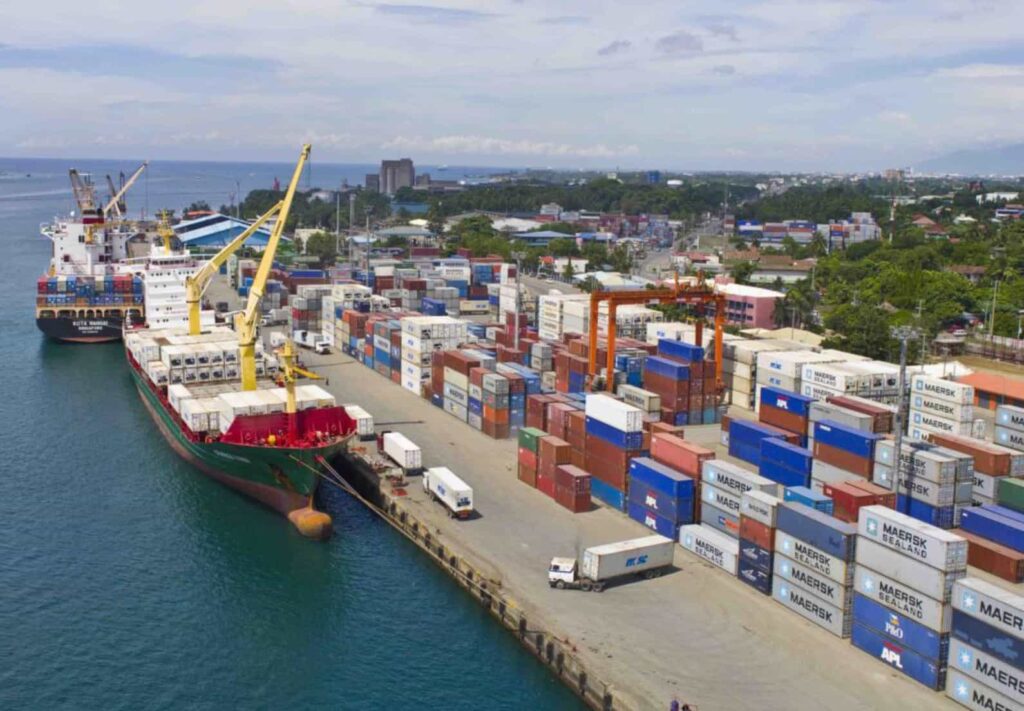
Shipping to, from, and within the Philippines is largely impacted by its geography. The country is an archipelago with over 7,600 islands, more than 2,000 of which are inhabited. It’s no surprise, then, that seaports are crucial to its shipping infrastructure. Seaports outweigh airports in number as well as the amount of cargo processed, averaging a container port throughput of more than 6 million TEU from 2008 to 2020.
For a quick geography lesson, the islands of the Philippines are divided into three major groups: Luzon in the north, the Visayan Islands in the center, and Mindanao to the south. Although Luzon’s population is larger than that of the other two groups combined, all three areas have their own major seaports and airports that you can read about below.
Major Seaports
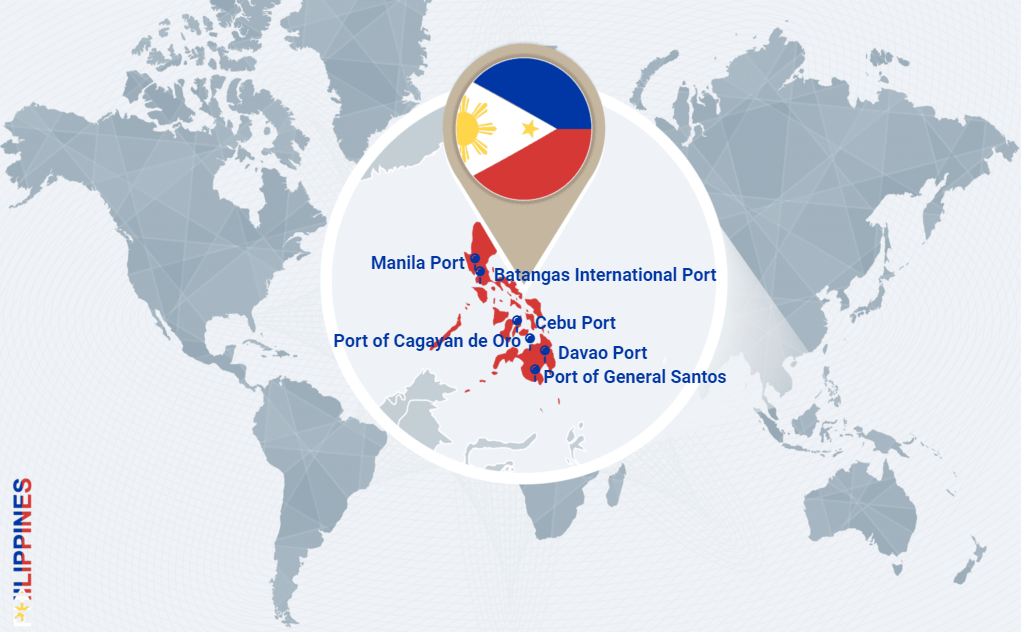
1. Port of Manila (Pantalan ng Maynila)
The largest port in the Philippines, the Port of Manila sits on the western side of Luzon in the capital city of Manila, facing the Manila Bay. Most of the country’s international shipments enter here, and the port handles an annual cargo tonnage over 75 million tons.
2. Port of Cebu (Pantalan sa Sugbo)
The Port of Cebu, while one of the largest international ports, is also the largest domestic port in the country. Located on Cebu island (part of the Visayan Islands), it mainly serves the Visayas and Mindanao island groups. Before the pandemic, over 15 million passengers passed through the Port of Cebu annually.
3. Batangas International Port
Also in Luzon, this port is the second largest in the Philippines and had an annual cargo tonnage of more than 2 million in 2015.
4. Port of Cagayan de Oro (Dakbayan sa Cagayan de Oro)
This port isn’t only one of the busiest in Northern Mindanao for cargo throughput, it’s also popular with cruise ships and ferries and is home to the biggest passenger terminal in the Philippines.
Major Airports
1. Manila Ninoy Aquino International Airport (also called NAIA Airport)
Prior to the COVID-19 pandemic, NAIA Airport is estimated to have moved over 700,000 metric tons of cargo annually and handled more than 45 million passengers in 2018. It’s located in the metropolitan area of Manila and is the primary international gateway into the Philippines.
The cost of shipping anything to the Philippines will vary depending on:
The size and weight of your shipment
Your shipment’s origin and destination
What shipping speed and form of transport you choose
However, paying for transport won’t be the only cost — don’t forget about importation taxes and tariffs. All goods imported into the Philippines are subject to duty and tax.
Luckily, the de minimis threshold for imports is PHP 10,000 (about $195). If your product is worth less than that, you won’t have to pay customs any additional duty or tax; this is great news for cross-border sellers looking to get exposure for their products in the Philippines. If your goods are worth more than that, you’ll have to pay a value-added tax (VAT) of 12%.
Keep in mind that this is calculated based on all your shipments in a single day, even if you send goods in more than one package.
If you want to look up tariff rates for specific products, the Philippine government has published this tool to help you be more prepared. Don’t be too worried, though. For countries with Most Favored Nation (MFN) status, the average tariff applied by the Philippines to imports in 2019 was just 5.5% for non-agricultural products.
What else should you consider?
Get Familiar with Rules and Regulations
The Philippines, like most countries, has its own rules and regulations for imports and the sale of commercial goods. You can read about import documentation here, but you should also be aware of commercial labeling rules for goods that will be sold domestically, imported or not.
Mislabeling products or filling out the wrong forms are good ways to get your goods sent back home.
Avoid Common Mistakes
If it’s your first time shipping to the Philippines, be careful not to make these simple mistakes:
Trying to import regulated or restricted items without a license or permit
Trying to import prohibited items
Incorrectly filling out customs documentation
Mislabeling addresses or submitting incomplete paperwork
Not considering duty tax and tariffs
Working with the wrong shipping service for your needs
One way to minimize mistakes is to partner with a logistics company with a local presence that can help guide you in the process.
Work with a logistics partner who has unique insight into the Philippine market
Shipping to a foreign country can feel like a tangled mess of laws, rules, and regulations, not to mention getting through customs isn’t even the last step. Your shipment still needs to reach its destination inside the Philippines, and as a fourth-party logistics (4PL) firm that’s officially entered the country, Wayfindr can help make that last mile happen.
As a 4PL firm, we offer full-service logistics coordination, working with our global network of experienced logistics partners to manage your shipping from start to finish. We’ll look at your business needs and make a customized logistics plan that gets your product wherever it needs to go.
Shipping to the Philippines with ocean or air freight? We’ve got you covered through our full-service logistics programs. Worried about getting through customs? We’ll help you with all that tricky documentation so your shipments don’t get delayed. Don’t know how to cover the last mile? Our on-the-ground partners in the Philippines will ensure your goods make it from the fulfillment center to the doorstep as smoothly as possible.
You can read all about how we landed our local partnerships here. Or, if you’re ready to start shipping to the Philippines yourself, give us a call or drop us an email to learn how we can help your business reach new markets.
Nick co-founded Wayfindr to help brands design and build market-leading carbon-neutral D2C logistics. As Director, he brings 15+ years of experience across logistics, marketing, supply chain and retail from Asia Pacific to the world.
We’re here to make things simpler for you – we won’t spam your inbox or blow up your phone. When you enter your information:
(Within 24 hours) A member of the Wayfindr team will read your request and schedule a meeting by email. A more in-depth form will be attached to the email.
We will ask you about your needs and specific logistics requirements.
We will take your information and put together a plan designed for your business.