Supreme Court Strikes Down Trump’s IEEPA Tariffs: What Importers Need to Know (Feb 2026)

We’ve all been dealing with the rollercoaster of Trump’s tariffs, making February 20, 2026 a huge day. After months of waiting, the Supreme Court ruled 6-3 that Trump’s IEEPA tariffs are illegal.
As a result, the “laws” Trump relied on to levy pretty much every country on earth are now invalid. Bye bye! However, the penguins on Heard and McDonald Islands don’t have cause for celebration just yet, and neither do you.
Trump signed a replacement within hours, so we certainly haven’t seen the end of tariffs, and then there’s the issue of refunds. Here’s what’s actually changed and what you should be doing about it.
Supreme Court Ruling On Tariffs: TL;DR
- The Supreme Court ruled 6-3 that IEEPA tariffs are illegal — they’re struck down
- Trump immediately replaced them with a 10% global tariff, then announced via Truth Social on February 21 that he would raise it to 15%. A formal signed order for 15% is pending
- The new Section 122 tariffs come into effect on February 24, but they have a 150-day limit, after which approval from Congress is required to extend
- The administration has other tools (Section 301, 232, 338) and has signalled it will use them. What the tariff picture looks like in the coming months is still very unclear
- For most brands sourcing from China or Vietnam, headline rates have dropped by 10% or 5% — but check what’s still in place before adjusting your landed cost models
- Refunds on tariffs already paid are now legally possible, but the process is unresolved, and the administration is fighting it
Explore more: Wayfindr’s Global E-commerce Logistics Services
What’s Actually Changed on Tariff Rates?

The IEEPA tariffs are gone, but those penguins will be keeping the champagne on ice for the time being. A few hours after the ruling, Trump signed an executive order imposing a 10% global tariff under Section 122 of the Trade Act of 1974, effective February 24.
He later increased that to 15%, the maximum that Section 122 will allow, but the higher rate has not yet been formalized (as at the time of writing).
The Section 122 tariffs sit on top of whatever other tariffs you were already paying before IEEPA came along. The tariffs that remain in place are as follows:
- Steel (up to 50%), aluminum (up to 50%), copper, lumber, and automobiles. These were levied under Section 232 of the Trade Expansion Act, on the basis of US national security.
- Section 301 of the Trade Act of 1974, based on “unfair trade practices.” These apply specifically to China, and include aerospace, electronics, semiconductors, plastics, furniture, auto parts, building materials, apparel, footwear, and other household items. Sorry, they’re all still in place.
What’s changed for brands sourcing from China?
IEEPA tariffs on Chinese goods peaked at 145% in April 2025, made up of a 20% fentanyl-related tariff and a 125% reciprocal tariff. Subsequent trade negotiations brought those IEEPA rates down over the course of 2025 to a combined 20% (10% fentanyl plus 10% reciprocal) before the ruling.
What remains are Section 301 tariffs (7.5%–25% depending on the product), which predate IEEPA entirely and weren’t touched by the ruling, plus the new Section 122 surcharge on top. It’s still not a low-tariff environment for China-sourced goods, but you do get a slight reduction compared to last week.
What’s changed for brands sourcing from Vietnam and other markets?
Vietnam faced a 46% IEEPA reciprocal tariff when Liberation Day tariffs were announced in April 2025. That was subsequently negotiated down to 20% as part of a bilateral framework deal in July 2025, which included a golf course for – guess who? Those negotiations were still IEEPA-based. So, Trump golf course or not, the IEEPA tariffs are gone.
The Section 122 tariffs apply instead. Similar to China, the net effect is slight reduction – either 10% or 5% – and that’s likely to be the case for the next few months.
For most other markets, the story is similar: IEEPA reciprocal tariffs that ranged from 10% upward are gone, replaced by the flat Section 122 rate. The net change varies by country depending on what rate they faced.
What Does Section 122 Mean For Tariffs?
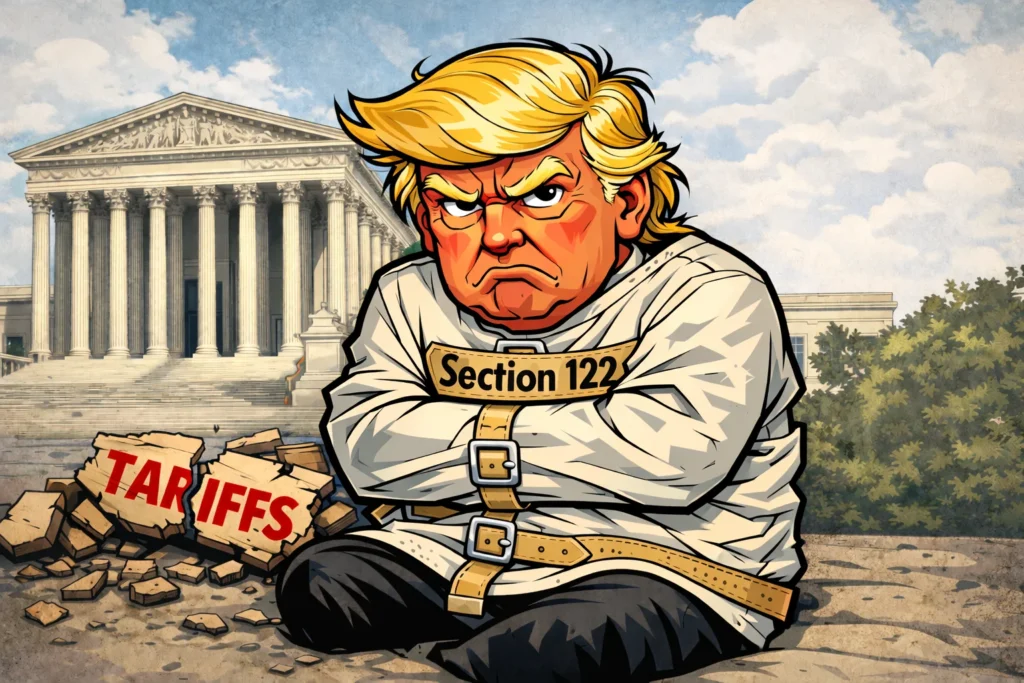
The section 122 provision has some serious constraints, which are now cramping Trump’s style:
- It expires in 150 days. The tariffs lapse automatically around late July 2026 unless Congress passes an Act to extend them. Trump can’t renew them by executive order.
- It’s capped at 15% and must be applied uniformly. The statute limits the surcharge to 15% and requires nondiscriminatory treatment across all countries — so it can’t be used to single out China for a higher rate the way IEEPA could.
Of course, there’s also an election in November, and many are predicting that the Republicans will lose control of one or both houses. Even if that didn’t happen, some Republican senators aren’t overly pleased with tariffs, so the chances of the Section 122 provision being extended are quite low.
The 150-day clock creates a few other problems. Section 301 requires a formal investigation before any country-specific tariffs are imposed — and those investigations typically take months to complete. There’s a real possibility of a gap between when Section 122 expires and when any replacement is ready.
The administration has also flagged Section 338 of the Tariff Act of 1930 as an option. This is a largely untested law that could allow tariffs of up to 50% on countries found to discriminate against US commerce.
Trump has had a setback, but he’s not done with tariffs yet. He has other tools to try, and it’s quite likely he will.
In short: the Section 122 tariffs may be the most clarity we get in the short term. If that helps your balance book, it’s worth taking advantage of it before Trump finds some other options.
What About Refunds on Tariffs Already Paid?
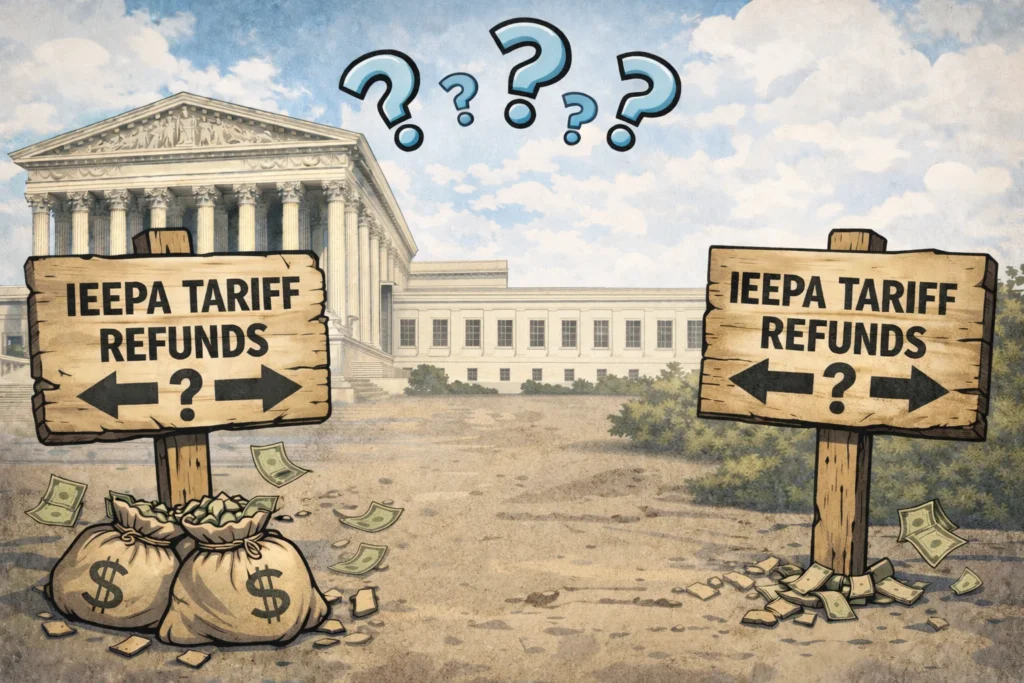
If you thought the tariffs issue was messy, brace yourself for refunds.
The Supreme Court said nothing about refunds. No process, no timeline, no eligibility rules. That silence cuts both ways: it didn’t rule them out, but it didn’t create a mechanism for them either. In effect, it’s up to the Court of International Trade (CIT) to work it out.
Based on well-established precedent, if a tariff is found to be incorrect or unlawful, you should expect refunds to follow. Unfortunately, it’s not always that easy, and you can be sure that the administration’s lawyers are looking for legal loopholes to side-step those precedents.
The numbers being discussed are pretty big. The Penn Wharton Budget Model puts potential refunds at $175 billion. Some put it much higher, like $300 billion!
Trump, at his post-ruling press conference, said it would “get litigated for the next two years.” That’s probably an accurate description of what’s coming.
How Will IEEPA Refunds Actually Work?
It remains to be seen how this all plays out. If you are to receive any type of refund, three scenarios are being discussed in trade law circles right now:
- Automatic refunds via CBP: The government processes refunds centrally without businesses filing individually. Small business groups are pushing for this. It’s also the least likely outcome given the administration’s position.
- Claims through your customs broker: The most practical near-term path. Your broker can pull entry summaries showing what IEEPA duties you paid and file protest amendments. If you haven’t spoken to your broker yet, that’s the first call to make.
- Litigation at the CIT: Over 1,000 cases are already filed. Companies with significant exposure are moving quickly to protect their position while the broader process is sorted out. Note: there are no class actions at this time.
If you’re a smaller importer, there’s an honest cost-benefit question here. For example, if your total IEEPA tariff bill was $40,000, spending $15,000–20,000 in legal fees to recover it may not make sense, especially with no certainty on timing.
What Should You Do?
Regardless of size, the practical steps are the same:
- Ask your customs broker to pull every entry where you paid IEEPA-based tariffs — fentanyl tariffs, reciprocal tariffs, the global baseline — and get documentation together
- Check whether those entries are liquidated or unliquidated, as it affects which refund route applies
- Review supplier contracts where tariff costs were passed up or down the chain — refund entitlements may not be as straightforward as they look
- Don’t plan your cash flow around a refund that isn’t confirmed. This will take time.
The CIT is expected to appoint a steering committee to manage the caseload. What comes out of that process over the next few months will define the path forward.
The Bottom Line

The IEEPA tariffs are gone, but we’re not out of the woods by any stretch. Rates have come down materially for most China and Vietnam-sourced goods, the legal basis has shifted, and there’s a 150-day window of relative clarity. Beyond that, the picture is as muddy as ever, and that’s the way Trump likes it.
If you want to talk through what this means for your supply chain costs and sourcing strategy, that’s exactly the kind of conversation we have with our clients. Wayfindr is the tech-enabled 4PL logistics partner helping global brands scale effortlessly — get in touch with our team, we’re here to help.