What Is 4PL (Fourth-Party Logistics)? How It Works and When You Need One

You’ve got a warehouse in Los Angeles, a freight forwarder in Hong Kong, a 3PL (third-party logistics) in the UK, and a European returns partner you found six months ago who’s OK but not great. Each of them needs managing, none of them talk to each other, and somehow, keeping all of it working has become your problem.
A fourth-party logistics provider (4PL) is built for this kind of situation. A 4PL manages your entire logistics operation. It coordinates your warehouses, freight forwarders, and carriers, pulls everything into one platform, and becomes your single point of contact for all of it. A 4PL doesn’t own the warehouses or trucks itself. It manages the people who do.
Whether that’s worth it depends on where your business is right now. This guide covers what a 4PL does, how it differs from a 3PL, and how to work out which one you need. We run a 4PL for a living, and have done so for over 10 years, so most of what follows comes from doing the job rather than describing it.
What is 4PL logistics? TL;DR:
A 4PL (fourth-party logistics provider) manages your entire logistics operation instead of running any single part of it. It selects and coordinates the 3PLs, freight forwarders, and carriers that your logistics program needs, pulls them into one platform, and becomes your single point of accountability. A 4PL owns no warehouses or trucks, but it does own the technology and the outcome.
The short version:
- A 4PL manages your whole logistics operation rather than handling specific logistics tasks itself.
- 4PLs are usually asset-light, so they’re not tied to specific warehouses or routes. That flexibility is the whole point.
- A 4PL works by coordinating multiple 3PLs and carriers under one platform and one point of contact.
- A 4PL makes most sense when you’re operating across multiple markets or managing more logistics relationships than your team has bandwidth for.
- If your logistics is simple and contained within a single market, a good 3PL is probably all you need.
Read More: Wayfindr Lift, our 4PL solution for B2B brands
What does a 4PL actually do?

A 4PL runs the moving parts of your logistics on your behalf. We choose and coordinate every 3PL, freight forwarder, and carrier in your network, integrate them into one platform for real-time visibility, and become your single point of accountability for how it all performs. Think of a control tower: We sit at the top of the operation and direct it, rather than flying any one plane.
So, how does it work? Say you make and sell rubber ducks. Cute, floaty rubber ducks. The kind with a cult-like following all around the world, and you’re ready to build a rubber duck empire to meet the demand.
The problem is, getting rubber ducks to their adoring fans isn’t quite as easy as you first thought. You need several freight forwarders who specialize in different regions, and each country has its own systems, tax requirements, and local 3PLs.
Suddenly, rubber ducks don’t seem nearly as cute or fun as they did before. You’re spending your days chasing shipping updates, reconciling tracking data that never quite matches, and trying to work out why a pallet you booked days ago still hasn’t left after being bumped off a full ship. Now you’re waiting for the next one. Classic.
A 4PL is the logistics partner who gets all your ducks in a row (sorry, couldn’t resist). We sit above your entire network, coordinate every provider, route shipments, and handle problems before they ever reach your laptop. The ducks get where they’re going, from every factory you work with, in every country, to every client in all your consumer markets. A 4PL gives you all that in one view, on one dashboard, overseen by one account manager. You get your sanity back.
How does 4PL compare to 3PL?
A 3PL carries out specific logistics jobs and usually owns the warehouses and trucks to do them. A 4PL sits one level above: it owns no assets and instead coordinates all your 3PLs, freight forwarders and carriers through one platform and one point of contact. In short, a 3PL does the work, and a 4PL manages everyone who does it.
Naturally, there’s some confusion between 3PL and 4PL. Some warehouse-software providers call themselves 4PLs. Some 3PLs add a coordination feature and put the 4PL sticker on their marketing because it sounds impressive.
To be clear, 3PLs aren’t the problem here. Some of the best logistics companies in the world are 3PLs, and we work with plenty of them. The villain is the complexity of managing all of them at once for fulfilment across every market.
Why can a 3PL not do everything?
Back to the duck analogy:
Your 3PL is really good at getting freight from the factory to your warehouse in your primary market, and it may also be well equipped to handle fulfilment in that same market. However, that 3PL doesn’t have the infrastructure to do freight, warehousing, and fulfilment in your second market.
The traditional option is to find a new set of logistics providers to deal with freight, warehousing, and fulfilment in the new market. But then, you are probably managing 4+ providers.
The innovative option is to combine your primary and secondary markets’ logistics with a 4PL. This gives you access to a single dashboard where you get a holistic view of your entire global sales and delivery.
What is the difference between 3PL and 4PL?
The following comparison should help clear up any confusion:
| 3PL | 4PL | |
| What they do | Execute specific logistics functions | Manage the whole logistics operation |
| Assets | Usually own warehouses, trucks, and other equipment | Asset-light, focused on technology and coordination |
| Geographic scope | Often regional or one to two markets | Global, across multiple markets |
| Your relationship | One of several vendors to manage | Single point of contact for everything |
| Best for | Contained, straightforward logistics needs | Brands scaling across markets with complex logistics |
If you’re working with a 4PL, you’re still using 3PLs. The 4PL sits on top, coordinating the 3PLs beneath it. Both matter. The question is whether you need someone managing that coordination for you.
A 3PL can still be the right call for your needs, in which case our guide on what to look for when evaluating a 3PL provider covers the key questions to ask before you commit.
Scaling brands that come to us usually juggle three to five logistics relationships across various regions before they consolidate with a 4PL.
Is the 4PL model growing?
Yes, and fast. According to our 4PL Market Assessment, the global 4PL market was valued at $66.4 billion in 2024 and is forecast to reach $122.3 billion by 2032, growing at a CAGR of 8.1%. The market is set to nearly double in under a decade.
A few converging pressures drive this growth:
- rising cross-border trade
- increasingly complex international supply chains
- brands’ growing demand for real-time visibility across their whole operation
E-commerce is where the growth curve gets really interesting. In 2026, about 75% of e-commerce companies still work with 3PL providers, but that’s changing. The same report shows that leading e-commerce brands are actively moving to the 4PL model to obtain the agility a 3PL model just wasn’t built to deliver.
The 4PL segment within e-commerce logistics is forecast to grow at 12% CAGR through 2032, making it the fastest-growing segment in the entire e-commerce logistics market. That growth demonstrates how e-commerce changes logistics expectations, partly because end customers want to get their orders as quickly as possible.
Why do growing DTC brands benefit from the 4PL model?

Scaling DTC brands benefit from 4PLs for two reasons: flexibility and simplicity. A 4PL can reroute, switch providers, and adjust a logistics strategy without the need to start over when something changes. It turns a complex web of logistics providers into one relationship and one number to call. Most brands notice the difference the first time something breaks.
Flexibility
Say you’re using a 3PL that ships into a specific port in Germany because that’s where their warehouses are. Customs costs for that port suddenly spike. Now you’re stuck. Either you absorb the increase or you go back to the drawing board and find a new provider. And often, you don’t find out until your ducks are already on the water.
We see that coming, and give you alternatives before it becomes a crisis. We’re not tied to specific assets, so we can reroute, switch providers, or adjust the strategy without starting from scratch.
Simplicity
If you’re shipping from Vietnam into Europe, the US, and Australia, you’re potentially looking at multiple freight forwarders, a 3PL in each market, and separate companies managing returns. That’s a lot of relationships to maintain, a lot of systems to log into, and a lot of people to chase when something goes wrong.
We routinely move clients from that kind of setup onto one platform with one relationship. The day-to-day of logistics stops being their job and becomes ours.
One of our customers, Takomo, makes golf gear across two production bases and sells into three markets (with more coming soon). We keep the whole network coordinated, so 98% of orders are fulfilled within 24 hours. And when peak season hit with extreme spikes, we only needed a week’s notice to meet the new demand.
How do you know if you’re ready for a 4PL?
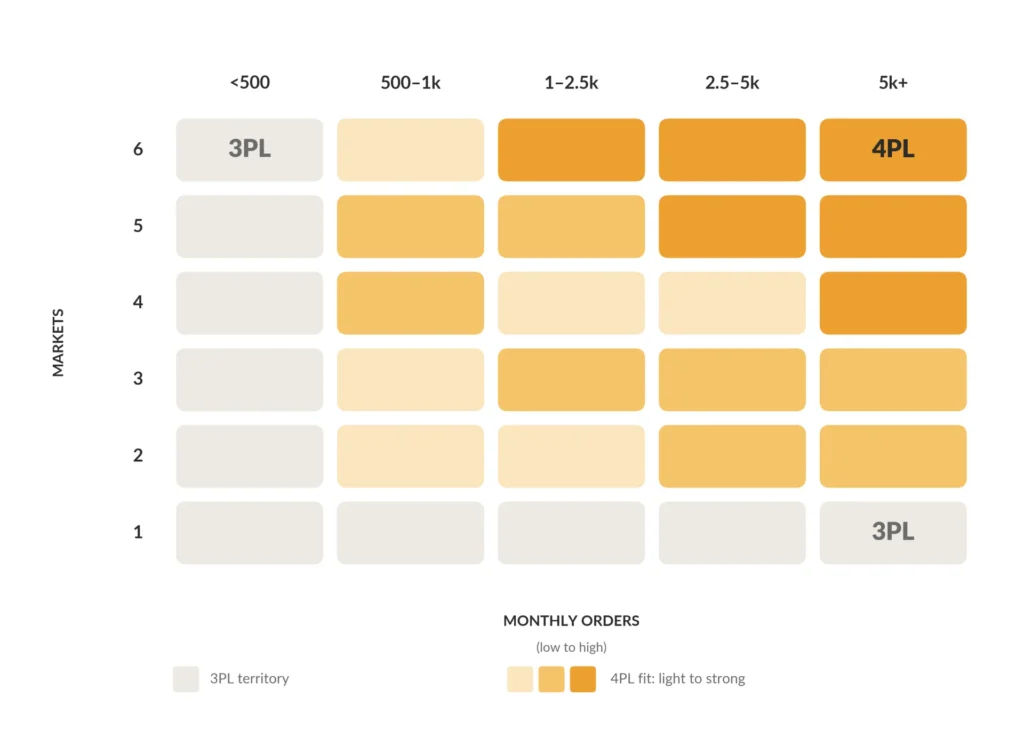
You’re ready for a 4PL when the complexity of your logistics outgrows your capacity to manage it. Usually, the problem is everything stacking up at once, with more markets, more providers, and more systems that don’t talk to each other. Add to that, more decisions with no one to own them. That’s precisely when a 4PL can help.
The warning signs we hear about most often:
- You’re managing three or more logistics providers and keeping them aligned has become a job in itself
- You’re expanding into new markets but your current provider doesn’t cover them, so you’re building new relationships from scratch each time
- Your team is spending significant time chasing updates, resolving discrepancies, or translating information between different provider systems
- You want a single dashboard showing your whole logistics network in real time, rather than logging into four different portals and hoping everything matches
- You need strategic advice on customs, compliance, or how your logistics is structured, and your current providers aren’t set up to offer it
If none of those apply, you’re probably not there yet. That’s fine. And when the time comes, our guide on how to choose a 4PL provider covers what to look for and the questions to ask before you commit.
Typically, brands we onboard bring us in when they enter their third market and handle 1,000+ orders monthly.
When should you stay with a 3PL instead?
Not every brand needs a 4PL, and we’ll tell you that directly. If you sell in one or two markets, use one or two logistics providers, and your team can manage those relationships without too many headaches, a strong 3PL is probably the right answer. It’s unnecessary and costly to add a coordination layer to a simple operation.
The 4PL model earns its place when coordination itself becomes the problem. When you’re juggling five providers across three continents, and nobody has the full picture, that’s the moment a single orchestrating partner starts to pay for itself. Until then, a good 3PL and rational thinking are sufficient.
Final Thoughts

At some point, every growing brand hits the same wall. The logistics that worked fine at 500 orders a month start creaking at 5,000. The two providers that were easy to manage become five, then eight, then a full-time coordination problem with its own Slack channel and more than a few grey hairs.
That’s the moment a 4PL stops being an interesting concept and starts being an obvious solution. One partner, one platform, one number to call when your rubber ducks are in Rotterdam again.
Wayfindr is the tech-enabled 4PL logistics partner helping global brands scale into new markets without logistics getting in the way. If your operation has outgrown your current setup, talk to our team about Wayfindr Lift. Running mostly e-commerce? Our fully managed e-commerce logistics with Wayfindr Go is built for that.