4PL Growth in APAC Expected to Grow 10.8% Overall & 12% Adoption Expected Among E-Commerce Brands

Asia Pacific (APAC) is the world’s fastest-growing region for 4PL (fourth-party logistics), at a predicted 10.8% CAGR (compound annual growth rate) through 2032. Meanwhile, e-commerce brands are projected to adopt 4PL usage at a 12% CAGR throughout the same period.
Put those two stats together, and APAC’s 4PL growth makes it a market that deserves your attention if you are in the e-commerce space.
But what does expanding into APAC entail?
E-commerce businesses frequently find they are managing three freight forwarders, two fulfilment centres, and a carrier in Singapore that has never heard of a carrier in Jakarta. And that’s before an end user gets their hands on the product. It becomes complicated quickly.
APAC is spoken of as one market, when it’s actually several markets in a trench coat, each with its own infrastructure maturity, customs logic, and consumer expectations.
What does that mean for any brand building its APAC strategy right now? It’s time to change up your logistics approach. The brands getting this right are consolidating the complexity of order fulfilment in multiple markets under a single point of accountability. Enter the 4PL.
APAC 4PL Market Growth: TL;DR
- APAC is the fastest-growing region for 4PL logistics globally, projected at 10.8% CAGR from 2025 to 2032. That’s faster than North America (7%) and Europe (5.4%).
- The APAC 4PL market is forecast to grow from $19.7B in 2025 to $44.7B by 2032, thanks to e-commerce growth, infrastructure investment, and rising complexity with cross-border freight.
- Key growth markets sit at different maturity stages: Singapore, China, Hong Kong, Taiwan, and Australia are mature, India and Vietnam are accelerating, and Thailand, Indonesia, and Malaysia are emerging.
- 4PL adoption among leading e-commerce brands is projected to grow at 12% CAGR through 2032, as brands demand single-point accountability over fragmented fulfilment.
- Around 25% of the global 4PL market is logistics optimisation, meaning brands are buying visibility, orchestration, and strategic control.
- Brands entering or scaling in APAC without a unified logistics strategy face compounding coordination costs that add to complexity.
Explore more: Download the full report to discover why e-commerce brands are rethinking logistics.
What does the APAC 4PL market actually look like right now?
The APAC 4PL market was valued at approximately $19.7 billion in 2025 and is forecast to reach $44.7 billion by 2032. It equates to a 10.8% CAGR that makes it the fastest-growing 4PL region on the planet.
Compare that to North America, which is growing at 7%, and Europe at 5.4%. APAC is pulling away faster than Trump can impose a new tariff.
How does APAC 4PL growth compare to the rest of the world?
The global 4PL market was valued at $66.4 billion in 2024, with projections pointing to $122.3 billion by 2032 at an 8.1% global CAGR. APAC currently accounts for approximately 29.7% of that global market.
By 2032, APAC is projected to be the single largest regional 4PL market in the world, overtaking both North America (forecast $38.6B) and Europe (forecast $29.5B).
APAC CAGR
10.8%
APAC 2032 forecast
$44.7B
Largest 4PL market by
2032
Source: Wayfindr 4PL E-Commerce Report, Cognition Solutions / Market.Us, December 2024
If you are already operating in North America or Europe, sit with the numbers. The region you are probably thinking about expanding into next is also the one adding logistics complexity faster than anywhere else.
Why is APAC growing faster than every other region for 4PL logistics?
APAC’s 4PL growth comes from a convergence of factors that do not apply at the same intensity anywhere else: rapidly expanding logistics infrastructure, a fast-growing middle-class consumer base, surging cross-border e-commerce, and a baseline 4PL penetration rate that is still far below mature markets.
That gap is closing quickly, and that is precisely where the growth comes from.
Infrastructure
The physical infrastructure that makes 4PL possible is being built at pace, with heavy investment in port capacity, road networks, and warehouse development across various APAC countries.
- Completion of Singapore’s Tuas Port will enable a handling capacity of 65 million TEUs annually. It will be the world’s largest fully automated port.
- Thailand is continuing with a US$31 billion Land Bridge project. Part of this is connecting two deep-sea ports through road and rail infrastructure.
- Warehousing in India is projected to reach US$35 billion by 2027. Increasing consumption, digital adoption, and policy-led infrastructure development are at the forefront of this growth.
- Vietnam’s seaport upgrades, to accompany growing road infrastructure, is targeting a capacity of up to 1.5 billion tons by 2030.
E-commerce expansion
APAC is home to half of the top 10 e-commerce markets globally, and by 2030, 30% of FMCG sales will happen here. It’s faster and more consumer-driven than anything North America or Europe experienced at equivalent development stages.
Singles Day volumes from China alone dwarf most Western e-commerce peak events. The 2025 festival generated US$238.3 billion in sales, up 14.2% year-over-year.
Structural maturity
Unlike North America and Europe (where brands gradually moved from 3PL to 4PL as complexity grew), many APAC brands are skipping the multi-3PL phase entirely and moving straight to orchestrated 4PL models. It turns out that watching two decades of Western logistics fragmentation from the sidelines is a reasonable shortcut.
Cross-border freight
APAC cross-border freight involves multiple customs regimes, different carrier ecosystems in every market, regulatory frameworks that change faster than most internal logistics teams can track, and documentation in several languages.
That is the exact problem that fourth-party logistics was built to solve. The market is growing fast, partly because the problem it solves is growing faster.
Why does APAC benefit from 4PL more than North America or Europe?
North America and Europe are mature 4PL markets. In North America, the challenge is optimisation, basically wringing efficiency from well-established infrastructure. In Europe, it is compliance due to customs, VAT, and regulatory variations across borders.
APAC is both of those problems simultaneously, across multiple markets at different development stages, with carrier ecosystems that do not connect. However, APAC’s predicted growth rate (10.8%) is higher than the predicted global average of 8.1%, reflecting a booming market waiting to be taken advantage of.
| Region | Predicted Growth Rate | Infrastructure Maturity | Core Logistics Challenge |
| Global | 8.1% | Mixed | Mixed |
| North America | 7% | High | Optimisation |
| Europe | 5.4% | High | Compliance |
| APAC | 10.8% | Mixed | Coordination |
Source:Wayfindr 4PL E-Commerce Report
APAC is a coordination problem that a 3PL is not designed to solve. The 4PL value proposition here is structural.
Why does APAC create a logistics coordination problem that other regions do not?
Brands expanding across APAC face five logistics challenges: different customs regimes in every market, infrastructure at different stages of maturity, carrier ecosystems that do not connect, consumer expectations that vary widely by country, and regulatory environments that change rapidly.
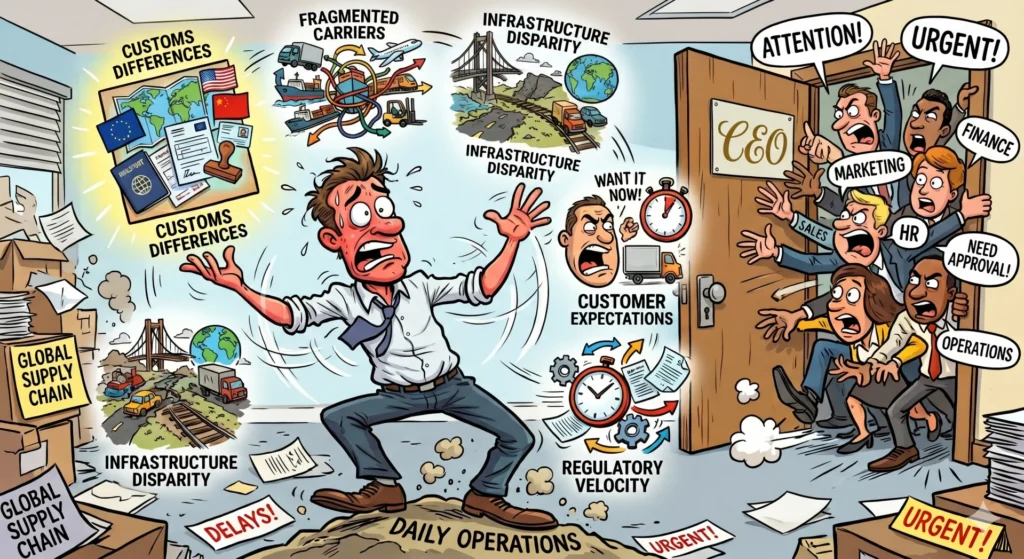
- Multiple customs regimes: Each market runs its own import logic, duty structures, and documentation requirements. A filing that clears in Singapore can trigger a hold in Indonesia. Brands usually discover this mid-shipment.
- Fragmented carrier ecosystems: Carriers that dominate one APAC market often have limited or no presence in adjacent ones. Scaling across Singapore, Indonesia, and India typically means managing four to six separate relationships with no shared visibility.
- Infrastructure maturity gap: Countries have different modes of fulfilment. Singapore’s port infrastructure and rural Indonesia’s road networks are not comparable, and they often fall within the same order flow. One fulfilment model does not stretch that far.
- Divergent consumer expectations: Delivery speed, returns handling, and last-mile experience differ significantly across the region. What counts as fast in Singapore is not the same benchmark a consumer in Vietnam or Thailand applies.
- Regulatory velocity: Cross-border documentation, tariff codes, and customs filings span multiple languages and evolving regulatory formats. Those formats change. Most logistics teams cannot track the pace without dedicated in-market expertise.
The compounding effect is the major issue. Each of these factors creates coordination overhead. Running all five simultaneously, across multiple markets, is the complexity tax that grows with every new market a brand enters.
A 4PL like Wayfindr was built to solve this complexity problem. This is why APAC brands are adopting the model faster than anywhere else.
Which APAC markets are leading the 4PL shift? Which are just getting started?
Not all of APAC is moving at the same speed. Singapore, China, Hong Kong, Taiwan, and Australia are the most mature 4PL markets in APAC, with India and Vietnam not far behind. Thailand, Indonesia, and Malaysia are emerging markets and have the strongest growth potential.
You want to focus on where each market sits on the maturity curve, especially if you’re deciding where to expand (and in what order). The maturity stage determines how complex your logistics setup needs to be from day one.
The five key markets in our research fall into three broad stages:
| Market Stage | Countries | Key Driver | 4PL Priority |
| Mature | Singapore China Hong Kong Taiwan Australia | Optimisation and visibility | Efficiency gains |
| Accelerating | India Vietnam | E-commerce surge and compliance | Carrier and customs management |
| Emerging | Thailand Indonesia Malaysia | Infrastructure and the middle class | Early market positioning |
Which countries have mature 4PL markets?
Singapore and China have done the heavy lifting. So have Hong Kong, Taiwan, and Australia. They have established carrier networks, solid port infrastructure, and 4PL adoption high enough that your competitors are probably already using one.
Here, logistics strategies focus more on optimisation and real-time visibility. Brands that invest in that layer tend to build a cost and data advantage that is difficult for late arrivals to match.
Which countries have accelerating 4PL markets?
India and Vietnam are doing a lot at once, including sustained infrastructure investment, explosive DTC growth, and a regulatory environment across customs, GST, and state-level rules that can surprise brands who thought they had logistics figured out.
A 4PL earns its keep through compliance management and carrier coordination. Build the right operational foundation now, and you have a market position that later entrants will spend years trying to replicate.
Watchlist: Vietnam
Vietnam’s logistics sector is growing faster than Thailand and Malaysia, with an expressway network on track to more than quadruple. Ports are racing to keep up. It’s not quite emerging anymore, nor is it accelerating, but it’s the market sneaking up the leaderboard while everyone’s looking elsewhere.
Which countries have emerging 4PL markets?
Thailand, Indonesia, and Malaysia are the markets that keep APAC strategists up at night in the best possible way: developing transport networks, a growing middle class, and e-commerce adoption moving so rapidly that no two quarters look the same.
A 4PL provides foundational support in these markets. They can secure carrier relationships, warehouse positions, and customs workflows before the market matures and the good positions are gone. Move early, and your competitor will struggle to find a foothold.
Why are e-commerce brands the fastest-growing segment for 4PL in APAC?
Previously, fourth-party logistics was the domain of heavy manufacturers and large retailers. That is changing quickly, and e-commerce is making it happen.
The logistics coordination problem e-commerce brands face is more acute than in other sectors, which is why they are projected to drive a 12% CAGR in 4PL adoption through 2032.
Source:Wayfindr 4PL E-Commerce Report
Are 3PLs still an option?
A 3PL arrangement works fine if you operate in one market with predictable volume.
It starts to fracture the moment you enter a new market, take on cross-border trade, or hit your first APAC peak season. Suddenly, you have three providers who have never spoken to each other.
Accountability becomes problematic. Each provider is responsible for their slice. Nobody owns the outcome.
If you’re managing several providers across multiple APAC markets, that gap is where orders get held at customs, where stockouts appear without warning, and where the real cost of fragmented logistics quietly adds up.
What about cost?
Running three to five 3PLs across APAC is more expensive and fragile than a consolidated 4PL arrangement.
In any market, you have to deal with:
- management overhead
- carrier coordination time
- customs errors that occur because nobody has a full picture of the operation
- stockouts that result from poor cross-market inventory visibility
These costs are real. They also added up quickly.
You can get rid of this complexity tax by using a 4PL. APAC 4PL logistics is a current market reality growing at a rate that rewards early positioning and penalises delay.
How can a 4PL save you money?
Fragmented logistics has a monetary cost, but it also takes time to chase providers, you don’t always know what a line entry on a customs invoice means, and you constantly have to worry about whether your shipment will be on time.
That changes with a 4PL. Around 25% of the global 4PL market is logistics optimisation.
Brands working with a 4PL logistics provider are buying visibility, orchestration, and strategic control. They get real-time inventory across every market, demand forecasting that works across multiple trade lanes, and a single team accountable for the whole operation.
What technology is accelerating 4PL adoption across APAC?
Technology is enabling APAC’s 4PL growth. The ability to give a business a single visibility platform across a fragmented carrier and warehouse ecosystem turns a coordination headache into a manageable operation.
We constantly see four technology themes driving this:
- Warehouse automation and AI-enabled warehouse management systems (WMS) reduce the manual overhead of running multi-site fulfilment across APAC. The result is more accurate inventory data, faster dispatch, and fewer costly discrepancies between what the system says is in stock and what is actually on the shelf.
- Cloud-based transportation management platforms with real-time tracking, route optimisation, and carrier performance management give you visibility across every shipment in the network.
- Control Tower platforms are the core technology of modern 4PL, where a single dashboard shows all freight, inventory, fulfilment and delivery status across the entire network.
- Last-mile innovation, specifically EV fleets and autonomous delivery, is emerging where consumers expect fast, low-friction last-mile delivery. This is not widespread across APAC yet, but it signals the direction.
What does 4PL growth in APAC mean for brands expanding into the region?
If you are scaling into APAC in the next 12 to 24 months, use 4PL market data as a guide.
At a predicted 10.8% CAGR, the 4PL market is adding infrastructure, carrier depth and logistics capacity every year. On top of that, 4PL growth is projected to increase by 12% CAGR between 2025 and 2032. That’s a lot of brands competing to work with 4PLs.
Build your APAC strategy now while carrier relationships are available and coordination costs are manageable. Wait too long, and the region’s fastest-growing freight corridors become busier than a padel court over a weekend.
The first-mover advantage in APAC logistics is real and underappreciated.
The brand that establishes its fulfilment presence in Indonesia or India in the next 12 months will have a negotiating advantage, institutional knowledge, and operational familiarity that a brand entering in two years cannot buy at the same price.
Want to know more about 4PL growth driven by e-commerce? Get the full report.
Is a 4PL Right for Your Brand?
Let’s do a quick gut check.
How many of the following are true for your business?
- You operate across 3 or more APAC markets. (Or plan to.)
- You are coordinating 3 or more logistics providers (and none of them talks to each other).
- Cross-border freight makes up more than 25% of your volume.
- Your inventory visibility depends on spreadsheets, Slack messages, or vibes.
- Your logistics lead is spending more than 10 hours a week chasing vendors instead of strategic tasks.
- You hope you calculated all the customs and tariff charges correctly.
Ticked three or more? A 4PL is what you need.
Conclusion
If you are scaling an e-commerce brand into APAC, the logistics complexity is not one to dive into headfirst. Multiple markets, fragmented carriers, customs logic that is different in every country, and peak seasons that make Western demand spikes look like a quiet Tuesday.
The brands growing fastest in this region are the ones that stopped trying to manage everything themselves. They opt for a 4PL.
You need one contact, one team, and a single point of accountability for the whole operation. That is what Wayfindr gives you in APAC.
If you are ready to enter APAC, contact us, and we’ll show you how tech-enabled 4PL logistics can help your brand scale effortless