International Shipping Disruption in 2026: How to Handle Tariffs, Fuel Surcharges & Trade Uncertainty

Take a moment to think about the comparatively carefree days of 2019. Back then, Wayfindr was known as Wayfindr Logistics, and getting products from point A to point B was reassuringly predictable.
Rates were generally stable, the logistics industry was evolving to meet the growth of global e-commerce, and everyone was doing just fine, thanks very much. Turn the page to 2020, and that version of the world was most likely consigned to the history books.
A series of seismic disruptions has impacted everything from shipping costs to warehousing, customs clearance, and last-mile delivery. If your cross-border costs and lead times feel completely chaotic, that’s because they are.
This article breaks down what has changed, what it means for your landed costs and delivery reliability today, and what you can actually do about it.
International shipping disruptions in 2026: TL;DR:
- COVID exposed how fragile the logistics ecosystem can be, but it was just a warm-up act for the disruptions that followed.
- US-China tariffs peaked at 127% in April 2025 before partial de-escalation down to 47.5% before the Supreme Court struck them down all together. The current (and temporary) tariffs stand at a 10% global baseline.
- The US eliminated the $800 de minimis exemption on August 29, 2025. The EU will follow in July 2026, and the UK by March 2029.
- If you’re shipping into the US, a B2B2C fulfillment model (where you import inventory in bulk at wholesale value and fulfill orders from a local US warehouse) can significantly reduce your tariff bill.
- Red Sea rerouting via the Cape of Good Hope added 10–14 days and up to 40% more fuel cost to Asia-Europe lanes and remains largely unresolved.
- The war in Iran has closed the Strait of Hormuz and triggered fuel surcharges across every major global carrier, with ocean freight spot rates on key Asia routes up 28-30% according to Xeneta, last-mile carriers like FedEx adding surcharges of up to 26.5%, and no sign of costs stabilising soon.
- None of this is just a “shipping” problem. It affects your whole logistics plan — warehousing, fulfilment, customs clearance, and last-mile delivery. Building flexibility across your whole supply chain is the only way forward.
Read About Wayfindr’s Adaptable 4PL Logistics Services
Why has international shipping & logistics become so unpredictable?
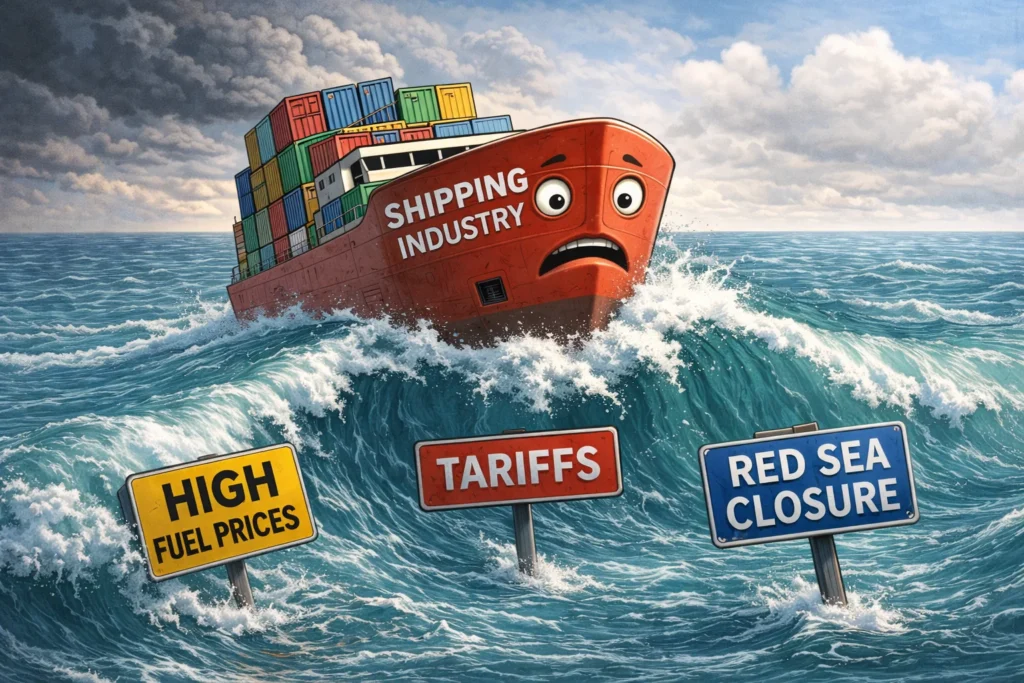
The short answer: a sequence of shocks since 2020 that has permanently changed how we operate. COVID-19 and the resultant lockdowns had a huge impact on global logistics, but many would argue that things have only gone from bad to worse since then.
Container rates on major routes increased tenfold during 2021. Businesses that were manufacturing in one country and shipping from one location quickly discovered why it’s such a bad idea to put all your eggs in one basket.
However, those rates eventually came down again, and people assumed things were going back to normal. We were all wrong on that front. Russia invaded Ukraine, attacks on shipping in the Red Sea meant a major route was inaccessible. Most recently, President Trump has taken what can only be described as a “wrecking ball” to international policy.
Global tariffs have upended a global trade framework that we all took for granted, but they’re not the only major change. De minimis exemptions in the US, EU, and UK have been eliminated, or will be very soon. That means low-value parcels now attract customs fees. Finally, war in the Middle East has caused a global fuel crisis, affecting everything from shipping to air freight and last-mile deliveries.
No one knows exactly how or when all this will end. It was fair to call COVID a disruption, but what has happened since has been far more significant. The rules that underpin how we all do business are changing in real time. When we’re talking about getting products from point A to point B, what worked in the past doesn’t work now.
How have tariffs increased costs for e-commerce businesses?

Current status of the tariffs (as of April 2026): Trump’s IEEPA tariffs were struck down by the US Supreme Court in a 6-3 ruling on February 20, 2026. Hours later, the administration replaced them with a 10% flat global tariff under Section 122 of the Trade Act of 1974, effective February 24. That rate is temporary — it expires around July 24, 2026, and the administration has signalled, it intends to restore previous tariff levels through Section 301 investigations. If you’re sourcing from China, the picture is more complicated: Section 301 tariffs (25%+) still apply on top, putting China’s effective rate at roughly 31–35% depending on the product category.
The word “tariffs” was among some of the most searched for terms in 2025, so we’ll cut straight to the chase and tackle the elephant in the room. From a logistics perspective, tariffs were most acutely felt if you were/are selling into the US, but they went beyond the actual cost of duties.
The tariffs were what grabbed all the headlines. But, you also would have seen delays at border entry points, lower profit margins, a possible drop in sales, and higher fees from customs brokers, the unlucky people left to figure it all out.
Unsurprisingly, this caused many companies to rethink how they operate. An Omnisend survey of 170 US-based e-commerce businesses, November 2025, found that 54% had already made significant changes to how they price, source, or sell because of tariffs, with 39% raising retail prices directly as a result.
In February 2026, the US Supreme Court struck down the IEEPA-based tariffs, but they were immediately replaced by similar provisions under Section 122 of the Trade Act of 1974. Section 301 is also being considered as a fallback, and investigations into “unfair trade practices” – as required by the Act – were launched in March 2026.
In short, Trump seems intent on keeping the centerpiece of his trade policy. As a result, we’re probably stuck with the current state-of-play until at least 2029. One change that’s likely to remain after 2029 is the elimination of de minimis exemptions, which we’ll cover next.
What happened to the de minimis exemption — and why does it matter?

Until August 2025, the US allowed shipments valued under $800 to enter duty-free with minimal paperwork. This exemption was known as de minimis, and thousands of direct-to-consumer e-commerce businesses used it as a central part of their business model.
However, some companies, such as Chinese platforms Shein and Temu, took it a little too far. They pumped millions of parcels into the US directly from Chinese warehouses. As a result, the US has cracked down, eliminating the $800 threshold as of August 2025.
NPR reported that around four million de minimis packages were being processed per day when the change took effect. The number of US-bound parcels valued under $800 has since fallen by 54%, according to the Universal Postal Union.
Following the US decision, the EU quickly followed, bringing forward plans to remove de minimis to July 2026. As a result, any parcel under the old €150 threshold will pay a flat-rate duty of €3 per item.
The UK also has plans to remove de minimis, but they’re moving more slowly. As of late 2025, the UK’s £135 threshold will be removed by March 2029 at the latest.
We recently wrote a piece that goes into much greater detail, but the key takeaway is this: if you shipped low-value products directly to customers in major markets, and you relied on de minimis exemptions as part of your pricing structure, you’ll need to rethink your strategy.
You can either raise your prices to reflect the new costs or consider setting up a compliant local entity to manage fulfillment in each market.
Fuel Costs & Surcharges for E-Commerce Businesses: Why Things Have Gone From Bad to Worse
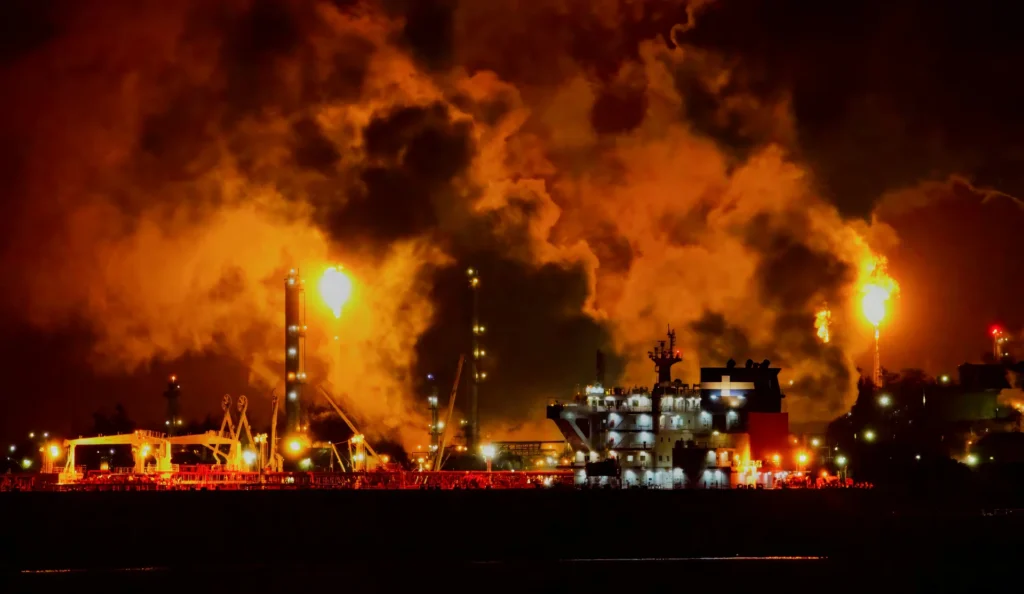
If tariffs gained all the headlines, fuel costs and surcharges crept up on us — at least initially. There have been two distinct shocks that are now impacting e-commerce businesses.
The first was the Red Sea crisis, which started in late 2023 and has never really been resolved. Then, on February 28, 2026, the US and Israel launched strikes on Iran. It’s fair to say that the resultant fuel crisis did receive a lot of attention.
The Red Sea: a logistics disruption that refuses to go away
Since late 2023, Houthi attacks on commercial vessels have effectively closed the Red Sea and Suez Canal to routine shipping. This corridor normally carries around 12% of global trade and up to 30% of container shipping, according to S&P Global, so its closure wasn’t just a minor inconvenience. It was a massive problem.
By early 2025, project44 data showed that container traffic through the Suez Canal had fallen by approximately 75% compared to 2023 levels. Most major carriers rerouted around the Cape of Good Hope, which is kind of an ironic name, given the circumstances.
This added 10–14 days to Asia-Europe voyages and, according to FreightAmigo’s 2025 logistics report, boosted fuel consumption by up to 40% per voyage. Rerouting a single container ship adds roughly $1 million in extra fuel costs, according to Maersk.
According to Logistics Outlook’s 2025 Red Sea analysis, freight rates on Asia-Europe routes surged fivefold in 2024 as a result. They eased from those peaks but remained 25–35% above pre-crisis levels as of late 2025.
A fragile ceasefire briefly gave some carriers confidence to resume limited Suez transits. However, the war in Iran has meant that things in the Red Sea are again looking shaky.
The Iran war: a bigger shock, still unfolding
On February 28, 2026, the US and Israel launched military strikes on Iran. The immediate consequence for global logistics was severe. Iran’s closure of the Strait of Hormuz — the narrow passage through which roughly 20% of the world’s oil and gas flows, according to UNCTAD — sent energy markets into shock.
Brent crude surpassed $100 per barrel on March 8, 2026, for the first time in four years, reaching $126 per barrel at its peak. That has had a direct effect on almost everything used by the logistics industry: shipping, air freight, road transport, and last-mile deliveries.
The other thing to understand is that carriers don’t just raise base rates when fuel costs spike. They layer on fuel adjustment factors, emergency surcharges, and war risk insurance premiums that can change weekly.
So, what does this all mean? Well, you have to factor in significantly higher costs to get things to your customers, and you can’t rely on a quote you received two weeks ago. Costs can, and do, change on an almost daily basis.
How should e-commerce businesses respond to all of this?

Honestly, there’s no playbook that covers everything we’re currently witnessing. But there are things you can do right now that will make your operation more resilient. We’ve created a short list of things to consider.
Start with your real cost numbers — not the ones you calculated last year
Most e-commerce businesses have a reasonable sense of their freight costs. Far fewer have a reliable, up-to-date picture of what duties, surcharges, customs broker fees, and last-mile costs are adding on top.
With tariff rates, fuel surcharges, and carrier pricing all shifting simultaneously, your landed cost — what it actually costs to get a product into a customer’s hands — needs to be a live calculation, not an estimate you came up with six months ago.
Of course, most businesses can’t manually change their website pricing every day, so a classic “set it and forget it” approach won’t work. Assume that tariffs are a long-term thing, and build in some extra wriggle room for fuel surcharges.
Some businesses are also using AI-powered dynamic pricing tools, which consider several factors, such as competitor prices and real-time fuel/freight costs.
Don’t rely on a single source, route, or provider
Every major disruption of the past five years has punished businesses that had all their eggs in one basket. That includes one manufacturing country, one shipping route, or one logistics provider.
Spreading risk across all three is the difference between a coherent global logistics program and a collection of separate arrangements that all break together at the first sign of trouble.
This doesn’t mean you need to duplicate everything. It means having a qualified second supplier you could call on. One shortcut is to work with a logistics partner who has a network rather than a single set of assets.
Read more about how supply chain disruption plays out in practice and what businesses have done to get through it.
Does it make sense to hold stock closer to your customers?
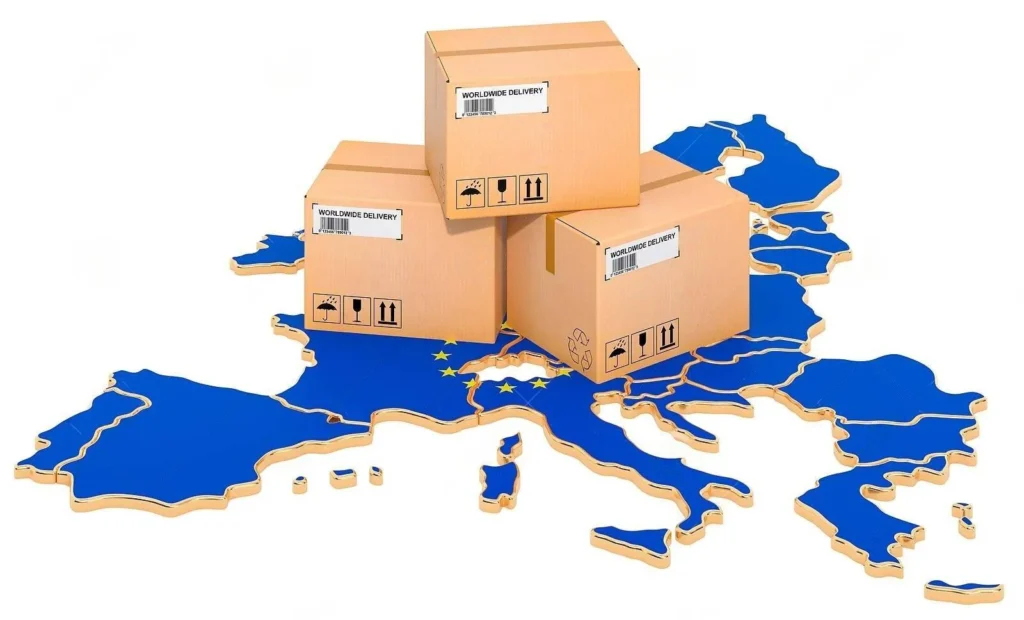
For most growing e-commerce businesses, yes — especially if you’re selling into the US or Europe. Shipping individual orders cross-border made sense when it was cheap, fast, and predictable. None of those three things is reliably true right now.
Holding inventory in-market means you aren’t so exposed when shipping is disrupted: something that’s happening a lot right now. It also means your customers will enjoy faster delivery speeds, which is always a good thing.
You don’t need to own warehouses to do this. Working with reliable third-party logistics providers (3PL) in each market will cover all the bases. If you find yourself managing too many providers, a fourth-party logistics provider (4PL) can streamline everything into a single point of contact.
If you want to understand the difference between 3PL and 4PL, we created an in-depth article covering the topic.
Here’s a rough guide to where to focus, depending on where you are right now:
| Where you are | Where to start |
| Smaller operation, one or two markets | Get a real-time view of your actual landed cost — duties, surcharges, broker fees, and delivery. You might be surprised by what you find. Ensure your pricing reflects those costs. Establish relationships with several logistics providers, so you always have a backup plan if needed. |
| Mid-size, expanding into new markets | In the past, it was realistic to manage expansion from one central location. That’s less viable in the current climate. Consider establishing local fulfilment points in key markets, as this helps reduce your exposure to shipping volatility. It also improves customer experience. |
| Multi-market, complex supply chain | If you’re managing three or more logistics relationships and someone on your team is spending most of their time on it, that’s a sign you need a different model. A 4PL gives you one view across everything and the flexibility to switch providers without rebuilding from scratch. |
Have an actual plan for when things go wrong
Most businesses set aside a contingency budget. That’s not the same as a contingency plan.
Yes, this all sounds like pie-in-the-sky stuff. “Have a plan.” Great, what does that actually mean? It means thinking through some broad scenarios. “What happens if that container arrives two weeks late?” “What do I do if shipping costs double overnight?” “Who will I turn to if my 3PL goes bankrupt?”
That distinction played out in real time during the Red Sea disruptions. Businesses that had thought “what happens if a shipment is delayed?” were ready to react. Those who hadn’t faced the joys of dealing with angry customers.
Here’s another very real example. In January 2026, Sendle — a popular delivery platform with e-commerce businesses in Australia — shut down overnight with no warning. Some Wayfindr clients were affected.
Because we operate across a network of providers rather than routing everything through one, we had alternatives in place within hours. Read what happened and how we responded.
It’s a good illustration of why contingency planning is so important. It also highlights one of the key benefits that a 4PL offers: options.
Consider the B2B2C fulfillment model for the US
If tariffs are eating into your margins on US shipments, this is worth knowing about.
What is B2B2C fulfillment?
B2B2C (business-to-business-to-consumer) is a fulfillment model where you ship inventory in bulk into the US as a wholesale transaction, then fulfill individual customer orders from a local US warehouse. You’re still selling direct to your customers. You’re just not sending individual parcels across the border every time someone places an order.
Why does it help with tariffs?
Tariffs are calculated as a percentage of the declared value of your goods. When you ship in bulk at wholesale value rather than retail, the taxable value is lower. That means your duty bill is lower too. It’s not a loophole. It’s just smarter logistics.
How does it actually work?
At origin, your goods are picked, packed, and consolidated into a bulk shipment. That shipment clears US customs as a B2B import, at wholesale value. Once it’s cleared, parcels go to a local US warehouse where domestic shipping labels are applied and orders go out via a US carrier. From your customer’s perspective, nothing changes. From your cost structure, quite a bit does.
Who is B2B2C right for?
It works best for e-commerce brands shipping meaningful volume into the US who are currently seeing their margins compressed by tariffs. If you’re sending a handful of orders a month, it probably doesn’t make sense. If you’re shipping containers, it likely does.
A few things you need to get right: an Importer of Record, clean documentation, and correct country of origin marking. If your goods are made in China, they need to be declared as such. Routing through Hong Kong doesn’t change that.
We’ve put together a full guide to how B2B2C fulfillment works if you want the detail.
When does it make sense to get outside logistics help?

Between tariffs, changes to de minimis, and a global fuel crisis, the case for getting help with your logistics has never been stronger. Even more so if you’re selling internationally. The question then becomes: which model is the right one?
If you’re shipping from one place to one or two markets and your volumes are manageable, a good 3PL in each market and a reliable freight forwarder will probably do the job. Remember, local fulfilment in each market eliminates at least some exposure to disruptions.
When you’re selling into three, four, or more markets, things can get a lot more complex, and that’s where a 4PL logistics partner starts to make sense. They don’t just coordinate your logistics; they can suggest what strategy is best for your particular setup. In times like these, that’s a very valuable asset.
Final Thoughts

There’s a temptation, at the end of an article like this, to say something reassuring. That things will stabilise, that the tariff situation will resolve itself, and that fuel costs will come down once the geopolitical situation has settled.
Yes, all those things are true, and it’s important that we stay optimistic. However, it’s equally important to be realistic. De minimis is gone, and it’s not coming back. The tariff wars have ruffled a lot of feathers, and you shouldn’t think there will be a group love-in when Trump’s second term ends. International trade relations will probably feel the impact for decades.
For an international e-commerce business, that means adjusting to a new status quo. Whereas once it was fine to ship directly to customers from one location, now it can make more sense to have local fulfilment in every market. If logistics was something your team could manage before, you might now find that you really need some expert support.
Wayfindr is the tech-enabled 4PL logistics partner helping global e-commerce businesses find the right strategy, including through exactly this kind of disruption. If you want to talk through what resilience actually looks like for your operation, the team is here.