What Does Peak Season Logistics Look Like in Each Region in 2026?

Peak season is the best stretch of the year to grow a brand across borders. Every region has its own big moments, from Singles’ Day in APAC to White Friday in the Gulf, and each one is a chance to meet customers when they’re most ready to buy.
Peak season logistics is the planning, stock positioning, and delivery work that gets orders to customers during the busiest shopping weeks of the year. Those weeks fall on different dates in different places, and they grow at different speeds.
This guide covers APAC, UK & EU, the Middle East and Africa (MEA), and the Americas. You’ll see what each region spent in 2025, what drives its season, and what to plan for in 2026.
You can’t copy-paste peak season. You have to know each market well enough to sell to it differently.
Regional Peak Season Logistics: TL;DR
- Peak season logistics works best as four plans, because APAC, UK & EU, MEA, and the Americas each follow their own calendar.
- MEA is growing fastest at +20.5% a year on average, ahead of APAC at +12.5%, the Americas at +11.3%, and UK & EU at +4.6%.
- Each region has its own anchor events, from Black Friday in the US to Singles’ Day and Diwali in APAC to White Friday in MEA and El Buen Fin in Mexico.
- A 4PL with infrastructure in every region can match the logistics to each market’s calendar while the brand deals with one team.
Explore more: Five ecommerce peak season predictions for 2026
What is regional peak season?
Regional peak season is the busiest shopping stretch in a given part of the world, set by that region’s own events, holidays, and shopping habits. It starts and ends on different dates in different regions, so a single global peak season date misses most of them.
Black Friday is one anchor among many. Singles’ Day carries APAC, White Friday carries the Gulf, Sinterklaas carries the Netherlands, and El Buen Fin carries Mexico. Some regions open in September, and some keep selling after Christmas, so a warehouse can be busiest for one market in October and for another in the week after Christmas.
How much do shoppers spend in each region during peak season?
Our research shows that MEA is growing fastest at +20.5% a year on average, followed by APAC at +12.5%, the Americas at +11.3%, and UK & EU at +4.6%. The biggest ecommerce event sits in APAC, where Singles’ Day reached about $238B in 2025.
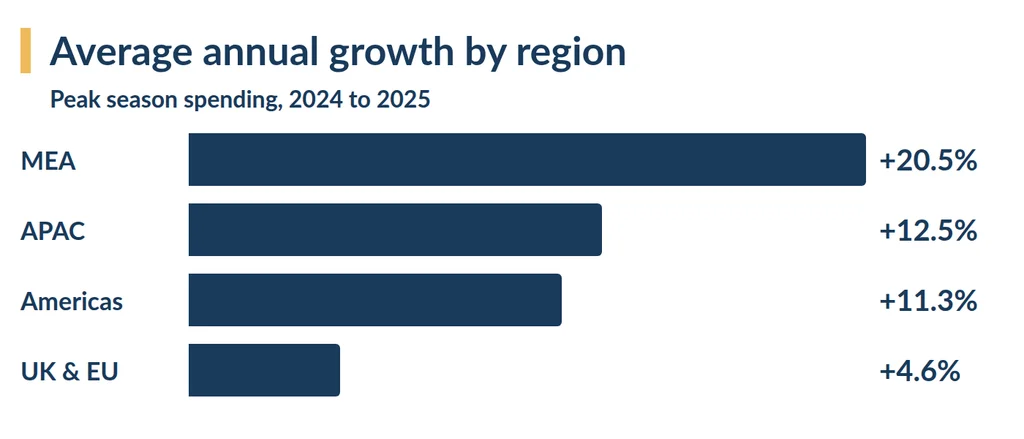
Those growth rates show where volume is building fastest. MEA is growing about four and a half times as fast as UK & EU, so a brand selling in both is planning for two very different peak seasons. (Hopefully, that planning isn’t happening on a spreadsheet with 10 tabs, because a shipment will be missed or end up in the wrong place.)
What does peak season look like in APAC?
APAC peak season runs on sale dates rather than one event. Southeast Asia has 10.10, 11.11, and 12.12… well, they like to pretty much treat any month with a double number as a sales date. India has Diwali, China has Golden Week and Singles’ Day, and Australia and New Zealand have Black Friday and Boxing Day.
APAC peak season spending has grown by around +12.5% a year on average.
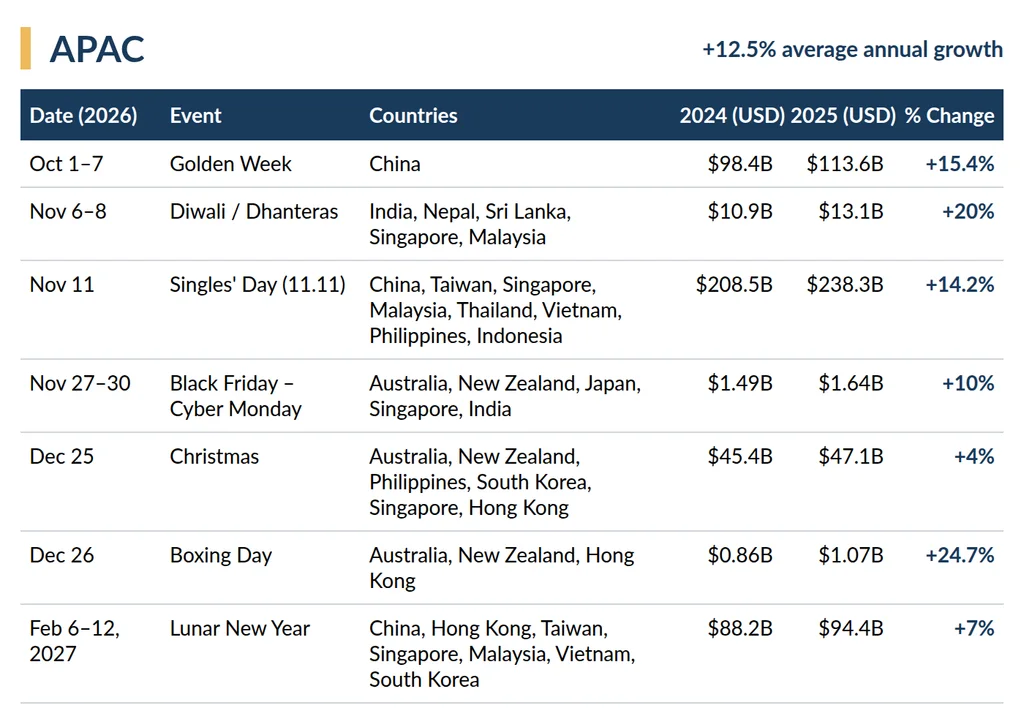
In APAC, peak season comes in waves, not one rush. The Southeast Asian double-date sales arrive one after another, and Singles’ Day lands more than two weeks before Black Friday. Golden Week runs from 1 to 7 October, so China’s season is already under way before the November sales begin.
Diwali falls on 8 November in 2026 and is India’s biggest shopping festival. Australia and New Zealand shop during the Black Friday to Cyber Monday window and again on Boxing Day, and both countries are a long way from the warehouses that serve other regions.
What does peak season look like in the UK and EU?
UK and EU peak season grows more steadily than other regions, at +4.6% a year on average, and its events vary by country. Black Friday week is shared, but Sinterklaas belongs to the Netherlands and Boxing Day to the UK, so the dates that matter depend on where the customer lives.
UK & EU peak season spending has grown by around +4.6% a year on average.
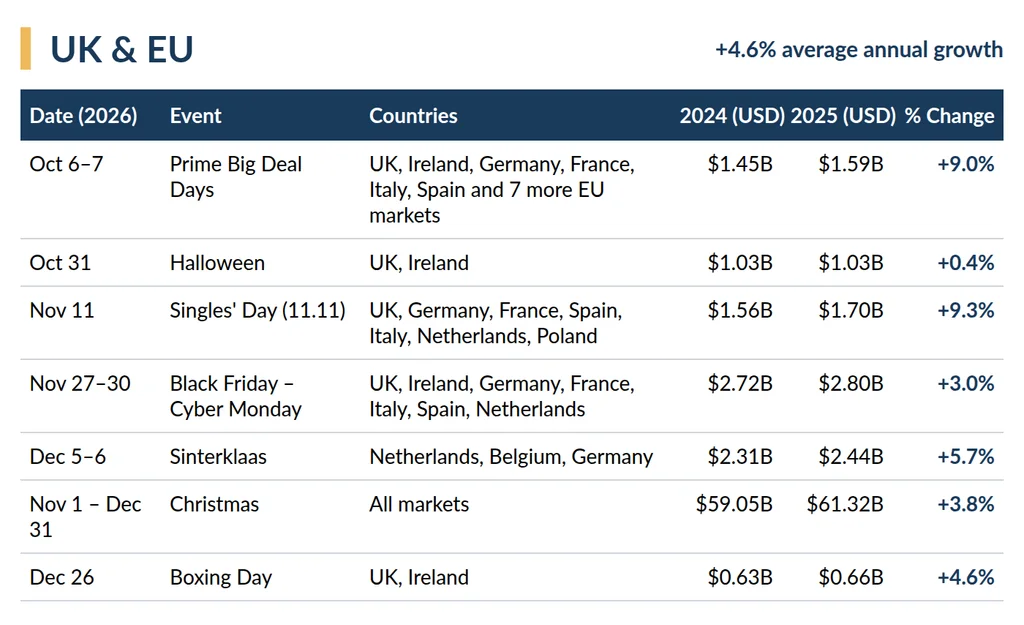
Sinterklaas is the Dutch gift-giving tradition, centred on 5 and 6 December, so Dutch orders need to arrive before most of Europe is thinking about Christmas. (Santa has a rival in the Netherlands, and he arrives first.)
Customers in the UK and EU generally have 14 days to return an online order. Parcel lockers and pick-up points are a common way to receive an order in much of continental Europe, while UK customers more often choose home delivery.
What does peak season look like in the Middle East and Africa?
MEA is the fastest-growing peak season region, anchored by White Friday and the National Days. The Gulf and South Africa behave as two separate markets, with the Gulf growing at +26.7% a year and South Africa at +8.2%.
MEA peak season spending has grown by around +20.5% a year on average.
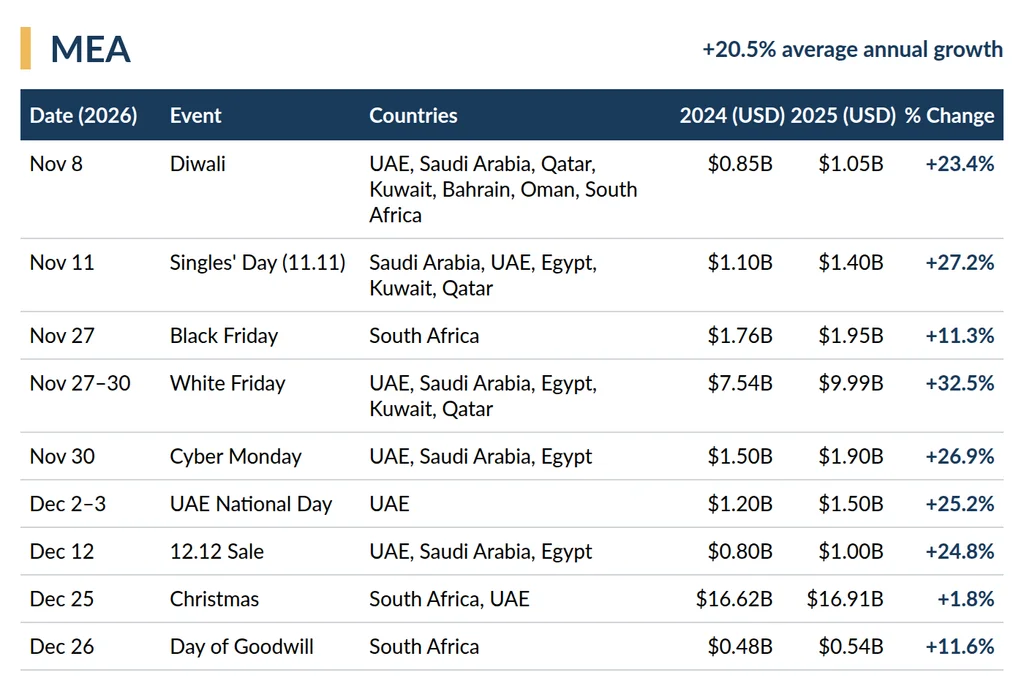
Saudi National Day on 23 September and UAE National Day on 2 and 3 December sit either side of White Friday, so the Gulf season opens before Black Friday and closes after it. Saudi Arabia’s weekend is Friday and Saturday, while the UAE’s is Saturday and Sunday, so carriers’ working days differ between the two countries.
Instalment payments (buy now, pay later) are common in the Gulf and in South Africa, and cash on delivery is still used in parts of the region. South Africa’s main event is Black Friday.
We didn’t consider other African markets because it’s difficult to obtain data. Potentially, this is because many homes have no formal street address, the infrastructure isn’t always ideal, and cash on delivery is common, which makes ecommerce logistics much harder to plan.
What does peak season look like in the Americas?
The Americas combine the biggest absolute spend with very different markets. The US and Canada run Thanksgiving to Cyber Monday and Boxing Day, while Mexico focuses on El Buen Fin.
Americas peak season spending has grown by around +11.3% a year on average.
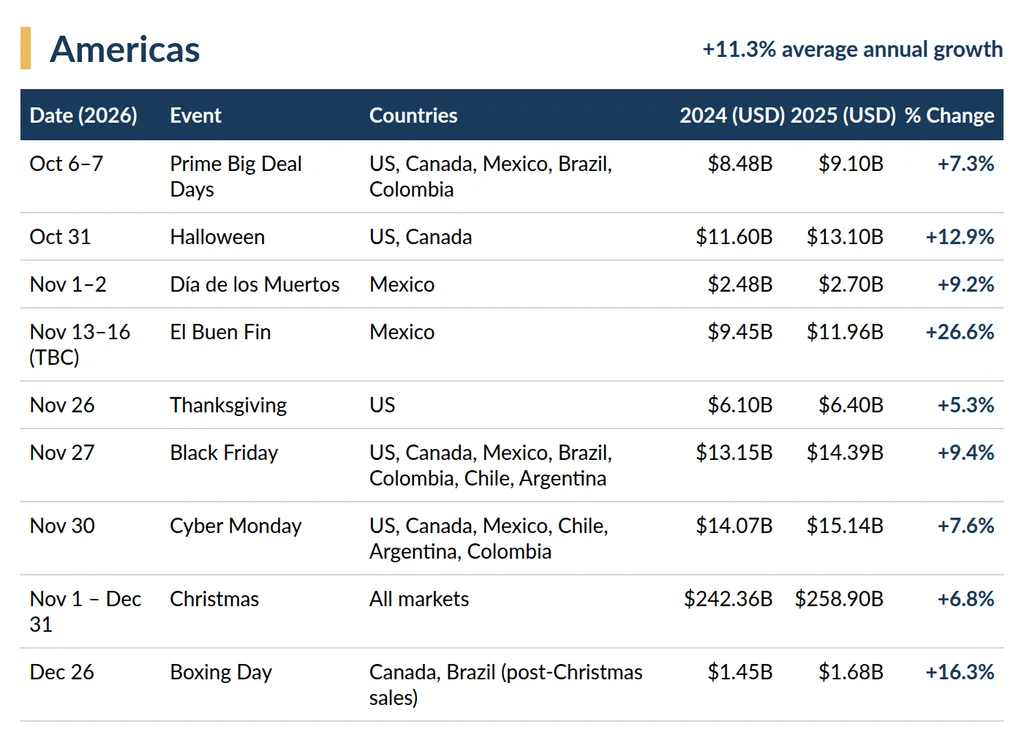
In Mexico, El Buen Fin arrives in mid-November, about two weeks before Black Friday, and it set a record of MX$219 billion in 2025. Meanwhile, in the US, it’s one event after the other with Halloween, Thanksgiving, Black Friday, and Cyber Monday all in quick succession. Canada’s season carries past Christmas into Boxing Day, which is another opportunity to capture some share of wallet.
Many US carriers add peak season surcharges to parcels shipped during the busiest weeks, so the cost of delivering each order rises at exactly the time order volume does. On top of that, if your brand passes a certain volume threshold, you can expect even more fees.
How do you adapt logistics to each market for peak season?
Start with how each market buys, then build the logistics around it.
The offer, the dates, the payment method, and the border all change what has to happen in the warehouse and with the carrier. A plan that follows each market’s calendar and habits allows brands to align their stock, delivery promises, and returns with demand.
How does the offer change the logistics?
Do research into the market, how they shop, and what kind of deals they respond too.
For example:
- Americans respond to a straight discount, so US pricing needs to include the carrier’s peak season surcharge. Otherwise, a discount that looks healthy can lose its margin on shipping.
- Gulf shoppers often consider a bundle of two or three items as better value than the same amount knocked off the price. Set each bundle up as its own SKU, so the warehouse picks it as one item and your stock counts stay accurate.
How early does stock need to be in each market?
Plan around each market’s main sales dates.
El Buen Fin arrives about two weeks before Black Friday, so a brand selling in both Mexico and the US needs Mexico’s stock and customs clearance in place first. Dutch customers expect Sinterklaas gifts by 5 December, which is earlier than the UK’s Christmas deadline.
Stock that lands at the wrong time is expensive to fix, because moving surplus stock between markets, for example from the US to Australia, is cost-prohibitive. That is why the forecast has to be made market by market.
How do you plan inbound logistics when events follow each other quickly?
Some countries have several event days in rapid succession, and that means stock has to get to fulfilment centres at the right time. The question is how quickly stock can be replenished between them. Waiting for one sale to finish before booking the shipment for the next can be too late, because carriers are busier in peak season and capacity fills up ahead of each sale.
Book space for the next shipment before or while the current sale is still running. Then use the sales results to adjust the quantities, not to decide whether to ship.
What about returns during peak season?
In many markets, a legislated return window means Black Friday purchases can come back while Christmas orders are still going out, so the warehouse needs capacity for both flows.
Check the requirements for each market to see what is required for returns and payment processing. Then, once the product is back at the warehouse, ensure it is restocked quickly, especially if that stock unit is popular and could possibly go out to a different customer.
How do borders and duties change the peak season plan?
Every market has its own border steps, so decide for each one where the order ships from and who pays any duties.
The US, specifically, has substantial tariffs on goods from most other countries. Those charges can also change at a moment’s notice. However, duties are applied at the point when stock enters the country and not the tariff implementation date. In other words, stock that arrives early can still be free from tariff changes.
What about delivery times?
Delivery times tend to increase by 10–20% during peak season, so you need to manage expectations. Tell customers early about likely delays. For example, add a banner stating the delay to your website.
Peak season puts every carrier under pressure, but customers still expect fast delivery. If you don’t let them know about delays, it can negatively affect brand perception, which is the last thing a brand wants.
How can a 4PL help with peak season in different markets?
A 4PL coordinates logistics across regions, so each market’s plan follows its own calendar while your brand works with one team. We own the logistics strategy behind each market, from warehouses to carriers and customs, so your brand can get on with focusing on growing the business.
We work with you ahead of time. Our teams ask what you have planned and what’s coming in, then brief the warehouses, so an APAC restock, a Sinterklaas deadline, and El Buen Fin can all be covered even when they fall within weeks of each other and across different regions. We can even set you up in a new market within 45 days.
If plans change, we move quickly. We can switch a carrier, or divert stock to another warehouse in the same country, so a fast-growing market doesn’t wait on stock.
Your team writes the market-specific campaign, because that’s your craft. Once you know which markets you’re chasing, we make sure the logistics behind each one keeps up.
Conclusion
Success in various markets happens when you plan according to each one’s specific calendar. There is no one-size-fits-all strategy. Peak season is a lot more enjoyable as four well-run areas than as one big surprise.
Wayfindr is the tech-enabled 4PL logistics partner helping global brands scale effortlessly. If you know which markets you’re chasing this peak season, talk to us about a market-specific logistics plan for peak season 2026.