Procurement vs Supply Chain vs Supply Chain Management: What’s the Difference?
We’re guessing you didn’t wake up this morning desperate to learn the difference between procurement and supply chain.
You were probably busy refining your product, making website tweaks, updating your ads, and wondering why one tiny app subscription now costs the same as a family holiday. While you focus on all that, logistics are sitting quietly in the background, plotting how to ruin your day.
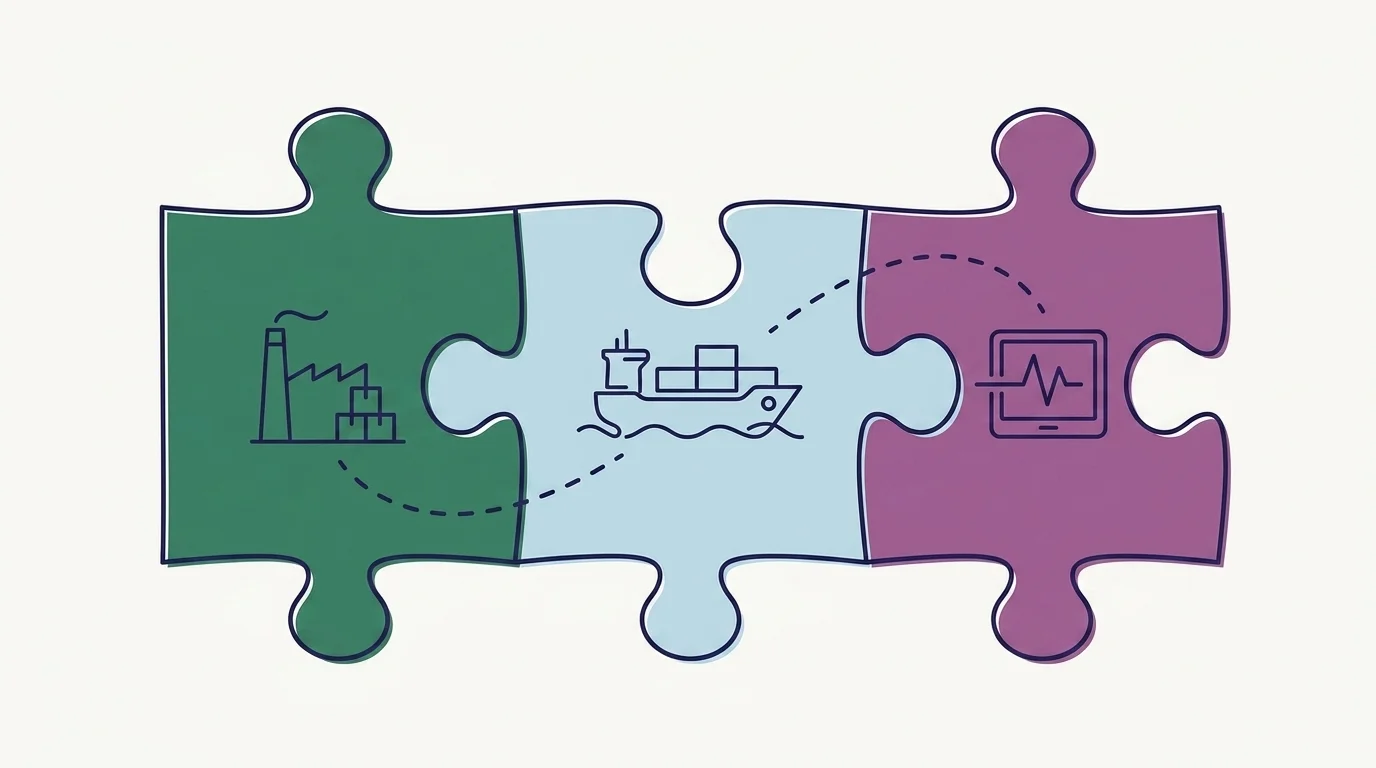
So, here’s what logistics peeps mean when they talk about supply chain and procurement. Your supply chain is the entire system that takes a product from raw materials to the customer’s door.
Procurement is the function within the supply chain, focused on sourcing and acquiring everything your business needs to operate.
Supply chain management (SCM) recognizes that the whole show is connected, and aims to improve overall performance by coordinating everything. Get all three right, and you’ll be a long way down the road to running a successful business.
Get them wrong, and you’ll quickly become acquainted with the joys of stockouts, delays, unpredictable costs, quality issues, and explaining to customers why their parcel is apparently “in transit” for the ninth consecutive day.
Procurement vs supply chain vs SCM: TL;DR:
- Your supply chain is the entire system that moves a product from raw materials to the customer’s door. Logistics execution – delivering stuff to your customers – is a key part of this.
- Procurement is a function within that system — focused on sourcing and acquiring everything the business needs to operate.
- Supply chain management coordinates the whole operation. Think of it as the “oil” in a “well-oiled machine.”
- For most e-commerce brands, logistics execution gets attention first. But procurement can be just as important as you scale.
- They’re tightly connected. If one starts misbehaving, the others usually feel it pretty quickly.
- Outsourcing to a 3PL or 4PL is one way to get on top of supply chain management without building a full in-house logistics team.
Read About: Wayfindr’s Full Service Logistics
What is procurement?
Procurement is the process of finding, vetting, and buying the goods or services your business needs to operate. For an e-commerce brand, that could mean raw materials, finished products, packaging, components, or outside services.
It’s also not just “buying stuff,” despite what the word sometimes implies. Good procurement means choosing reliable suppliers, negotiating decent terms, keeping quality consistent, managing lead times, and avoiding the classic trap of chasing the cheapest option. Yes, price is important, but focusing on that alone is a recipe for disaster.
Procurement typically covers:
- Supplier sourcing and selection
- Price negotiation and contract management
- Purchase order management
- Quality control and supplier performance tracking
- Cost planning and budgeting
- Risk management and supply continuity
In corporate jargon, procurement is referred to as the “upstream” part of your business. It happens before products land in a warehouse, before they’re packed, and long before customers start leaving happy or angry reviews (tip: procurement often influences which type of review you’ll get).
You shouldn’t think of procurement as a one-time task. Costs can change, you might need product revisions, or new suppliers might enter the market. Remember those reviews? Staying on top of procurement helps to keep them in the happy category.
The world has also become a lot less predictable. According to Resilinc’s 2024 disruption data, supply chain disruptions increased 38% year-on-year in 2024, with regulatory changes alone up 128%. Once again, this is where good procurement comes into its own, helping to at least minimize disruptions if things go pear-shaped (which is increasingly common).
What is a supply chain?
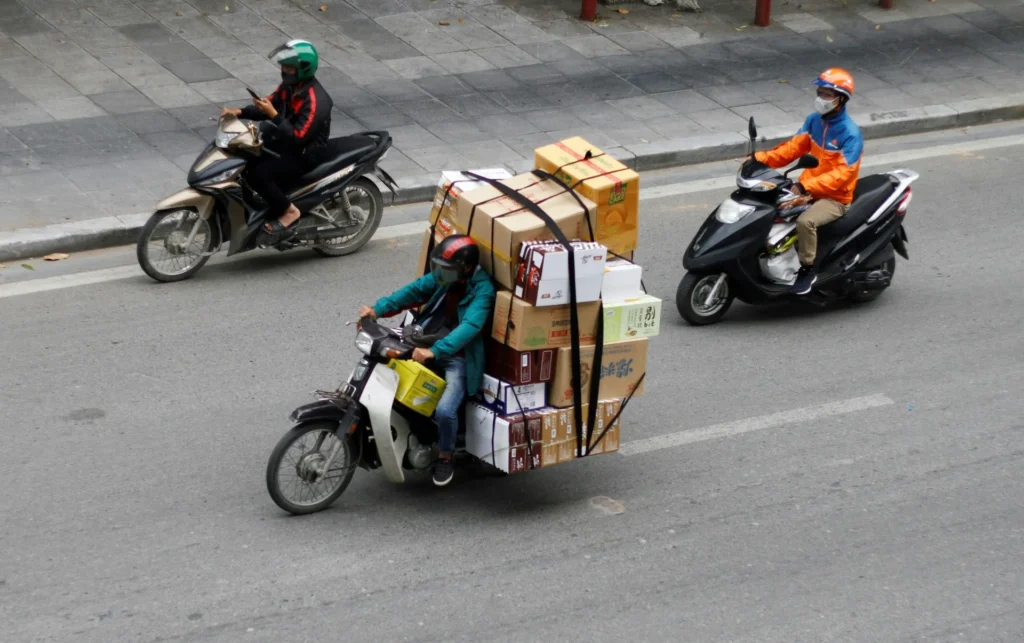
Your supply chain is the full end-to-end system that takes a product from raw materials all the way to the customer’s door. That means it includes everything: sourcing raw materials, manufacturing, procurement, warehousing, freight, fulfilment, and last-mile delivery.
Procurement, in other words, is part of your supply chain — the part that focuses on sourcing and acquiring what the business needs. The rest of it is logistics execution: getting goods from wherever they were produced to wherever they need to go.
In practice, when e-commerce brands talk about their “supply chain,” they usually mean the logistics execution part: getting stuff to their customers.
It might sound pretty simple, but there are a lot of moving parts in logistics execution. You may need international shipping – including customs clearances and figuring out which tariffs are in play this week – finding suitable warehousing, packing your products, last-mile delivery, and managing returns.
Here’s a more detailed list of what logistics execution can involve:
- Freight forwarding and customs clearance
- Warehousing and inventory management
- Order fulfilment and pick-and-pack
- Last-mile delivery to end customers
- Returns handling and reverse logistics
- Retail distribution, where relevant
(If retail distribution is part of your plan, getting goods onto physical retail shelves works differently from DTC the compliance requirements alone tend to catch brands off guard.)
If you’re selling across borders, this can quickly become a complex task. Different countries have different delivery expectations, regulations, tax rules, carrier networks, and operational quirks.
For most early-stage e-commerce brands, the logistics execution side gets attention before procurement does. That’s easy to understand. The most urgent early question is usually: “Can we get orders to customers without everything going belly up?” Later on, you’ll start to realize that procurement is also super important.
Related Reading: Centralized vs. Decentralized Supply Chains: What’s the Difference?
How do procurement and supply chain compare?
Because procurement sits inside the broader supply chain, the more useful comparison for e-commerce brands is between procurement and the logistics execution layer — the part most people are actually referring to when they say “supply chain” day-to-day. Here’s how those two functions differ in practice.
| Procurement | Logistics Execution | |
| Focus | Sourcing and acquiring goods and services for the business | Getting products from your supplier to the customer |
| Key activities | Supplier vetting, contracts, quality control, invoicing | Freight, warehousing, fulfilment, last-mile delivery, returns |
| When it becomes critical | When quality and reliability are critical to your business | From the first day you receive orders |
| Common failure points | Over-reliance on a single supplier, inconsistent quality | Long delivery times, poor visibility, high costs |
| Who manages it | Procurement team or outsourced partner | Logistics team, 3PLs, 4PLs |
The important thing to understand is that these functions are connected, whether you manage them that way or not. A weak procurement decision often turns into a logistics problem later. Pick the wrong supplier, and you end up with delays, shortages, or poor-quality stock.
What is supply chain management, and why does it matter?
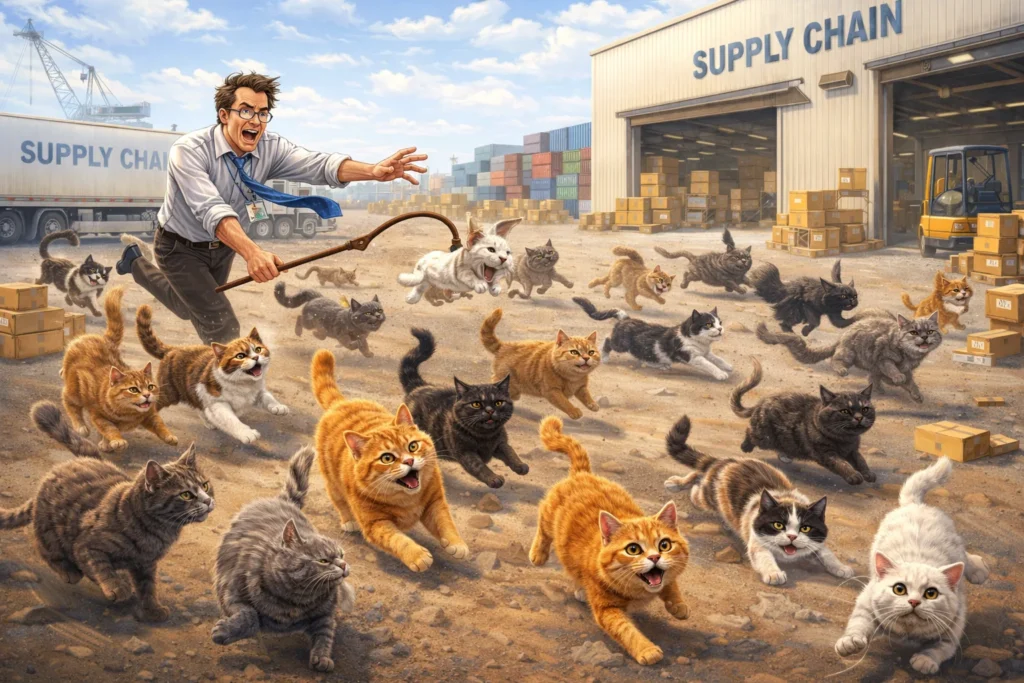
Supply chain management (SCM) is the job of coordinating and improving your full operation, from sourcing right through to delivery. It covers both procurement and supply chain execution as one, interconnected operation. Sounds easy, but some have likened it to “herding cats.”
At a large business, you might have a Chief Supply Chain Officer running a whole team of planners, analysts, and operations leads. At a smaller e-commerce brand, it’s often one operations manager, one founder, and one chaotic spreadsheet doing far too much heavy lifting. Either way, the objective is the same: keep the whole machine running smoothly.
That typically includes supplier coordination, demand forecasting, inventory planning, shipping strategy, logistics performance monitoring, and spotting bottlenecks before they start creating problems. If you think that sounds like a lot of work, welcome to the world of logistics!
There are a few ways that businesses approach SCM, the first being dedicated software packages. The global SCM software market is projected to reach USD $48.59 billion by 2030 (Grand View Research, 2024), so it’s definitely a popular option.
The second is to work with a specialist logistics partner. Third-party logistics (3PL) and fourth-party logistics (4PL) providers both offer logistics coordination services, although it’s usually not a bread-and-butter capability for 3PLs.
4PLs, on the other hand, are built from the ground up with supply chain coordination in mind. Understanding how 4PL providers bring order to complex supply chain operations is worth a look if you’re trying to figure out what that coordination layer could look like for your business.
Which matters more: procurement or logistics execution?
As you’ve probably gathered from previous sections, both procurement and logistics are important. However, the amount of attention you give to one or the other can vary, depending on what you’re selling.
If your products are technical, specialised, or quality-sensitive, procurement often matters more. You might have less competition, so the challenge is making sure your sourcing and quality are reliable, because if they’re not, those unhappy reviews will start rolling in.
If you sell in a crowded market where lots of brands offer similar products, logistics execution often matters more. When the product itself isn’t the main differentiator, delivery speed, reliability, and cost control start doing a lot of the competitive heavy lifting. Getting the right fulfilment setup in place is often where brands in this position find the most leverage.
In even simpler terms: procurement ensures you have something solid to sell, and logistics makes sure customers receive their orders on time. You need both to do their job, but their importance can vary.
When should you consider outsourcing your supply chain management?

We’ve already mentioned that 3PLs and 4PLs can help with some or all of your supply chain management. The question of when you should actually work with a logistics specialist, and which one is best, comes down to the size and complexity of your operations.
In the early days, it’s pretty normal for one person to handle your suppliers, inventory, freight questions, fulfilment issues, and whatever fresh nonsense has popped up this week. That can work for a while, but it gets more and more challenging as your business grows.
When to consider a 3PL?
If you’re operating in one or two markets with a relatively straightforward fulfilment setup, a 3PL is usually the right first move. A 3PL handles specific logistics functions on your behalf — running a warehouse, managing pick-and-pack, or handling last-mile delivery.
You still take care of procurement – selecting the right suppliers and ensuring that quality and price are on point – but the 3PL takes the logistics execution headache off your hands.
That hand-it-all-off convenience is the whole appeal of a turnkey setup with a 3PL: one provider bundling warehousing, fulfilment, and shipping under a single contract, ready to run out of the box. Before you commit, it’s worth knowing when a turnkey logistics solution is worth it, and when it isn’t.
This model works well for thousands of smaller businesses all around the world. However, it starts to reach its limit if you’re managing several 3PLs across different markets, along with multiple production facilities. At that point, you might want to consider a 4PL, also known as a logistics “control tower.”
When does a 4PL make more sense?
A few signals that your operation has grown beyond what a single 3PL can handle:
- You’re shipping from one country but selling into three or more, each with different regulations and carrier expectations
- You’re managing multiple warehouses or fulfilment partners with no unified view of stock or performance
- Managing procurement is becoming more complex
- Customs, compliance, or import requirements are taking up meaningful time and carrying real risk
- Fulfilment problems keep surfacing, but it’s never clear where in the chain they started
- Your team is spending more time managing logistics relationships than growing the business
If several of those sound familiar, a 4PL is probably worth a serious look. The model is straightforward: rather than managing a collection of separate providers yourself, a 4PL sits above the whole network and runs it on your behalf.
You get one contact, one platform, and one team that already knows your operation and takes responsibility when something goes sideways — rather than three providers each pointing at the others.
The better 4PLs can even help with the procurement side of your operation, suggesting alternative production facilities that reduce costs. One example might be setting up a new center in Vietnam to avoid tariffs on Chinese imports.
The honest value isn’t just the time you save on coordination. It’s that problems get caught earlier, because someone is actually watching the whole picture instead of just their piece of it.
That matters even more given how volatile the environment has become. According to a 2025 Procurement Tactics industry report, supply chain disruptions cost businesses an average of 8% of annual revenue in 2024.
Case study: Takomo Golf

Client: Finnish direct-to-consumer golf brand, manufacturing in China and Hong Kong, selling into the US and Europe. Growing at over 1,000% year-on-year.
Problem: That kind of growth exposes every crack in your operation, fast. Takomo’s existing logistics provider couldn’t keep up. They had slow processing, poor communication, and no transparency on order status, which were creating constant customer service headaches.
On top of that, shipping heavy golf equipment from Hong Kong to the US and Europe for every order was neither efficient nor cheap. And with most of their manufacturing in China, they were increasingly exposed to tariff risk and had no fallback if something went wrong at the factory level.
Why a 4PL: Takomo didn’t just need someone to move boxes faster. They needed a partner who could think strategically about the whole operation — logistics and procurement — and get involved at the factory level when needed. A single-function 3PL wasn’t going to cut it.
What changed:
- Wayfindr set up a dedicated US fulfilment centre for standard orders, replacing expensive cross-Pacific shipping for domestic customers
- A dual-stream model was introduced: centralised fulfilment for standard products, direct cross-border shipping from China for custom and time-sensitive orders
- Wayfindr led the search for a manufacturing partner in Vietnam — qualifying suppliers, managing compliance checks, and handling introductions in-language — to reduce tariff exposure and give Takomo a more resilient production base
- Pick-and-pack processes were optimised specifically for Takomo’s product range, and a returns-handling solution was introduced
Outcome: Within six months, replenishment cycles were more efficient, inventory costs came down, and response times from the logistics team averaged under four hours — compared to the radio silence Takomo had before.
More importantly, the brand went from a single-source operation entirely dependent on Chinese manufacturing to a globally distributed supply chain with a secured Vietnam manufacturing partner and fulfilment centres expanding into the US and EU.
Read the full Takomo Golf case study
Final Thoughts

If there’s one thing worth taking away from all of this, it’s that procurement and logistics aren’t two separate problems: they’re two ends of the same process.
A great fulfilment setup built around poor-quality products is not exactly a recipe for happy customers. And a top-notch product that you can’t get to customers efficiently is just as likely to result in negative reviews.
The other thing worth saying honestly: this stuff tends to get overlooked when businesses are just starting out. You don’t need to have it all figured out on day one. But knowing what good looks like — and having a sense of when your current setup is starting to hold you back — puts you in a much better position than most.
Wayfindr is the tech-enabled 4PL logistics partner helping global brands scale effortlessly. If you’re trying to work out where the gaps are in your current setup, talk to the team — it’s usually a pretty quick conversation to figure out what’s worth fixing first.