Shipping To and From Vietnam – An Easy Overview
Vietnam has quietly become one of Asia’s manufacturing powerhouses. Exports reached $405.5 billion in 2024, making it one of the region’s top exporters. Electronics, textiles, footwear, and furniture flow out at record volumes, with the US taking in over $119 billion of Vietnamese goods.
If you’re sourcing from Vietnam, you’ll need to understand how to get products from factory to customer efficiently. The good news? Vietnam has solid infrastructure and straightforward procedures. The reality? There’s still plenty to navigate.
This guide covers the main considerations for shipping from (and to) Vietnam. By the end, you’ll understand what’s involved or realize why many businesses use a 4PL to manage it all.
Shipping To/From Vietnam, TL;DR
- Most goods can be exported from Vietnam; restricted items need permits
- Export requires commercial invoice, packing list, bill of lading, certificate of origin
- Shipping costs vary by route, mode, timing, and Incoterms (FOB most common)
- Main ports: Hochiminh and Vung Tau (Cai Mep is known as deep sea port) (south), Hai Phong (north); airports: Tan Son Nhat/HCM airport, Noi Bai/Hanoi airport
- Export clearance: 1-3 days with proper documentation
- Import into Vietnam: 8% VAT (through 2026), duties 0-150%, no de minimis exemption
- Complex operations often benefit from 4PL partners coordinating the entire supply chain
Explore more: Wayfindr’s Global Logistics Management Solutions
What Can You Ship From Vietnam?
Most commercial goods can be exported from Vietnam without major restrictions. Electronics, textiles, footwear, furniture, and agricultural products make up the bulk of Vietnamese exports and generally move freely through customs.
However, certain items are either prohibited or require special licenses before export. Here’s what you need to know.
Prohibited Export Items
Vietnam strictly prohibits the export of:
- Narcotic drugs and psychotropic substances
- Explosives, weapons, and military equipment (unless specifically authorized)
- National cultural relics and antiques
- Endangered wildlife and protected species
- Certain minerals and raw materials deemed strategically important
Restricted Exports That Require Permits
Some goods can be exported but only with proper licenses or permits:
- Wood and wood products (require forest product certification)
- Seafood and agricultural products (need phytosanitary or health certificates)
- Pharmaceuticals and medical devices
- Chemicals and hazardous materials
- Certain electronics containing sensitive technology
- Cultural items and artwork (depending on age and value)
If you’re exporting any of these, factor in additional time for obtaining the necessary permits. Your customs broker or logistics partner should be able to guide you through the specific requirements.
RELATED: E-Commerce Guide to Shipping from Vietnam to the US
What Documents Do You Need to Export From Vietnam?
Every export shipment requires a core set of documents for customs clearance and international transport. Missing or incomplete documentation is the leading cause of delays at Vietnamese customs, so it’s worth getting this right from the start.
Here are the essential documents you’ll need:
- Commercial invoice: Detailed description of goods, quantities, values, and Incoterms (agreement between brand and factory)
- Packing list: Itemized list showing how goods are packaged, with weights and dimensions
- Bill of lading (sea) or air waybill (air): Transport document and title of goods
- HS code classification: Harmonized System codes identifying your products for tariff purposes
- Certificate of origin: Proves goods were manufactured in Vietnam; essential for claiming preferential tariff treatment under trade agreements like CPTPP, EVFTA, or RCEP
- Export declaration: Filed electronically through Vietnam’s customs system, with FOB terms factory is in charge of this filing with the Vietnam Customs Authority.
- Special permits or licenses: Required for restricted goods (see previous section)
- Destination country requirements: Some countries require additional documentation, like fumigation certificates for wooden pallets, especially for Australia and New Zealand markerts
Vietnam has digitized much of its customs process through the Vietnam National Single Window system, which allows electronic submission of most documents. However, certain certificates still need to be presented in physical form during inspections.
And that’s just the documentation. Next comes understanding what you’ll actually pay to move those goods.
How Much Does It Cost to Ship From Vietnam?
Shipping costs vary significantly based on multiple factors rather than fixed rates. If you’re comparing quotes, you’ll quickly notice that the same shipment can have wildly different prices depending on the route, timing, and terms you negotiate.
Key Cost Drivers
Several variables determine your final shipping cost:
- Shipping lane and destination: For example: Vietnam to US West Coast is cheaper and faster than Vietnam to Europe or East Coast
- Mode of transport: Sea freight is cheaper but slower (3-5 weeks); air freight is faster but costs significantly more
- Seasonality and peak periods: Rates spike during peak season (September through early December) and major holidays
- Chargeable weight: For air freight, you’re charged based on either actual weight or volumetric weight, whichever is higher
- Fuel surcharges: Carriers add bunker adjustment factors (BAF) for sea or fuel surcharges for air
- Incoterms: Determines who pays for what (more on this next)
- Customs brokerage and handling: Fees for documentation, customs clearance, and local delivery
- Insurance: Typically 0.3-0.5% of cargo value
Rather than quoting specific rates that will be outdated by next month, it’s more useful to understand the structure and negotiate based on your specific needs. If you’re shipping regularly, volume commitments with carriers can secure better rates.
What Are Incoterms and Who Pays What?
Incoterms (International Commercial Terms) define exactly where responsibility and cost transfer from seller to buyer during shipment. Getting this wrong can leave you with unexpected bills or confusion about who handles customs clearance.
Here are the most common Incoterms for Vietnam exports:
| Incoterm | Supplier Responsibility | Buyer Responsibility | Best For |
| EXW (Ex Works) | Make goods available at factory | All transport, export/import clearance, costs from pickup | Buyers with strong logistics networks; seller wants minimal involvement |
| FOB (Free on Board) | Deliver to port, handle export clearance | Ocean/air freight, import clearance, destination delivery | Most common for Vietnam exports; clear division of responsibilities |
| CIF (Cost, Insurance, Freight) | All costs to destination port including insurance | Import duties/taxes, customs clearance, local delivery | Buyers wanting predictable costs to destination port |
| DDP (Delivered Duty Paid) | Everything including import duties and delivery | Nothing (except unloading at final location) | Offering “landed cost” pricing; supplier handles all complexity |
Most Vietnam exports use FOB terms because it provides a clean handoff at the Vietnamese port. The seller/supplier handles getting goods to the port, and through export customs, then you (or your agent) take over for international shipping and import clearance.
However, if you don’t have any logistics expertise or a professional who can manage the process for you, asking your supplier for DDP terms (where they handle everything) can be much easier. It just means you will pay more.
Where Does Cargo Leave Vietnam?
Vietnam has invested heavily in port and airport infrastructure over the past two decades, creating efficient gateways for exports. The key is choosing the right one based on your manufacturing location.
Major Export Seaports
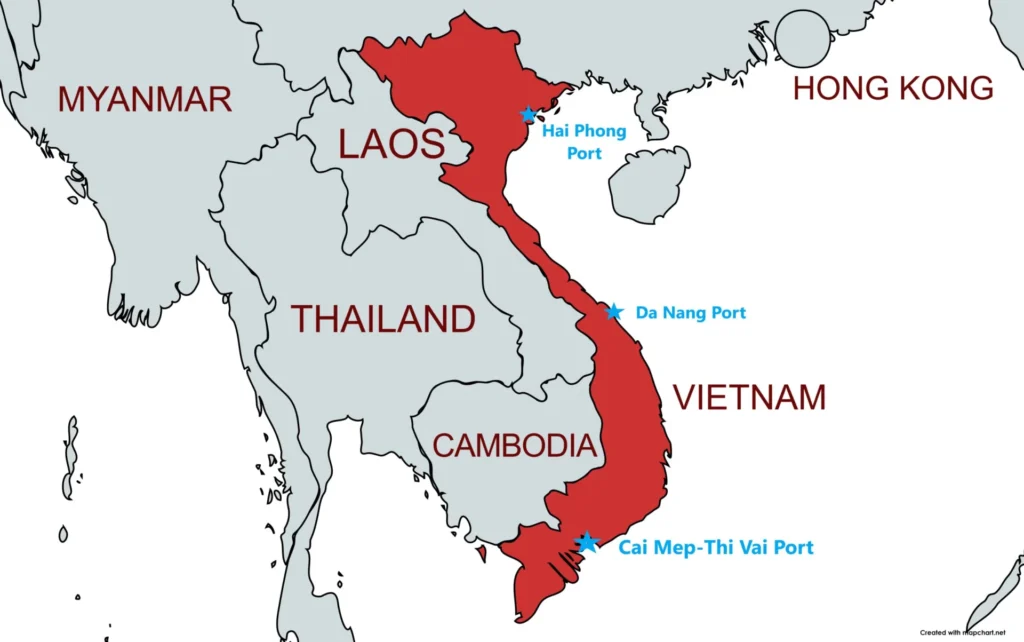
For sea freight, Vietnam’s main container ports are:
- Cai Mep-Thi Vai Port Complex: Vietnam’s premier deep-sea port located in Vung Tau (60km southeast of HCMC). The only port in Vietnam capable of handling ultra-large vessels up to 20,000 twenty-foot containers (TEU). Major terminals include CMIT, TCIT, and SSIT. This is where most large-scale international exports are processed, particularly for US and European routes
- Hai Phong Port: Northern gateway serving the Hanoi region and northern manufacturing zones. Excellent connectivity to factories in Bac Ninh, Thai Nguyen, and Haiphong industrial parks
- Da Nang Port: Central Vietnam option for factories in the Danang-Hue-Quang Nam corridor
The choice is usually straightforward: if your factory is in southern Vietnam, use Cai Mep port. Northern factories use Hai Phong or Cai Mep. Central locations can go either way depending on shipping routes and port capacity.
Major Export Airports
For time-sensitive or high-value shipments, Vietnam’s main air cargo hubs are:
- Tan Son Nhat International Airport (HCMC): Vietnam’s largest air cargo hub with extensive international connections
- Noi Bai International Airport (Hanoi): Northern air freight gateway with good coverage to Asia, Europe, and North America
Air freight costs 5-10 times more than sea freight but cuts transit time from 3-5 weeks down to 3-7 days. Use it for electronics, fashion samples, emergency replenishment, or anything where speed justifies the premium.
How Long Does Vietnam Export Customs Clearance Take?
Standard export clearance typically takes 1-3 days for routine shipments with proper documentation and no special inspections. Controlled goods, restricted items, or shipments requiring physical inspection take longer.
Vietnam has modernized customs through the Vietnam Automated Cargo Clearance System (VNACCS), allowing electronic filing and risk-based assessments. Most shipments receive automated clearance without physical inspection.
However, several factors can extend clearance time:
- Incomplete or incorrect documentation: The most common cause of delays. If your commercial invoice doesn’t match your packing list, or HS codes are questionable, expect customs to request clarification
- Restricted goods requiring inspection: Wood products, agricultural items, or anything needing special permits will be physically inspected
- HS code disputes: If customs disagrees with your product classification, they may require samples or additional documentation
- High-volume periods: Clearance slows during peak export season and major holidays
- Random inspections: Vietnam customs conducts random physical inspections on a percentage of shipments
Companies with Authorized Economic Operator (AEO) status benefit from expedited clearance and fewer inspections. AEO status requires at least two years of clean compliance history, but for regular exporters, it’s worth pursuing.
If you think handling all this sounds manageable, that’s great. But here’s where it gets layered: what if you’re also importing into Vietnam? Or shipping to multiple countries? Or managing multiple Vietnamese suppliers? The complexity compounds quickly.
What Are Current US Tariffs on Goods from Vietnam?

Photo by Natilyn Hicks Photography on Unsplash
As of February 2026, 24 July 2026, the US imposes a 12.5% Section 301 “forced-labor” tariff on most goods imported from Vietnam, in addition to standard HS code duties. This represents a significant increase from the pre-2025 average of around 3.3%, though it’s well below the 46% initially proposed under Executive Order 14257 in April 2025.
If you’re shipping to US customers, these tariffs will affect your landed costs and pricing strategy. Key details on the current tariff structure:
- Base tariff rate: 12.5% on Vietnamese goods, applied under Section 301 of the Trade Act of 1974 as a “forced-labor” tariff (effective 24 July 2026, replacing the interim 10% Section 122 surcharge, which had itself replaced the IEEPA-based 20% rate from August 2025)
- Applied on top of existing Harmonized System (HS) code duties
- Steel and aluminum: Additional 50% tariffs under Section 232
- Framework agreement: The US and Vietnam announced a trade framework in October 2025 that may provide zero-tariff treatment for certain products, but details are still being finalized
- Who pays: US importers pay these tariffs, though costs are often passed to suppliers or consumers
The tariffs were introduced as part of President Trump’s “reciprocal tariffs” policy originally imposed under the International Emergency Economic Powers Act (IEEPA). That policy was struck down by the Supreme Court in February 2026. It was replaced first by a temporary Section 122 surcharge and, from 24 July 2026, by the Section 301 “forced-labor” tariffs described above.
What Is the Transshipment Tariff from Vietnam?
Transshipment refers to goods that originate in one country (typically China) but are routed through Vietnam for minimal processing before being shipped to the US. This practice is used to avoid higher tariffs on Chinese goods.
US Customs enforces country-of-origin rules against transshipment: goods that merely pass through Vietnam without genuine, substantial transformation can be treated as their true country of origin (usually China) and taxed at that country’s rate. A 40% penalty on transshipped goods was set under the July 2025 US-Vietnam reciprocal framework, but that framework was an IEEPA measure struck down in February 2026, so the current status of that specific 40% figure is unconfirmed. What hasn’t changed is the principle: genuinely Vietnamese-made goods are fine; relabeled or lightly-processed foreign goods are the target.
Some uncertainty still exists around these tariffs:
- No clear definition: The Trump administration has not publicly disclosed exactly how it defines “transshipment” or what level of processing in Vietnam would qualify a product as Vietnamese rather than transshipped
- Enforcement unclear: According to the Lowy Institute, it’s “infamously difficult to measure and distinguish” transshipments from legitimate exports, and many Vietnamese firms lack the detailed records needed to prove origin
- Risk for importers: US companies face uncertainty about whether their imports will be classified as transshipped and hit with the 40% rate, and, if so, what penalty rate applies
As we saw many times in 2025, the current state of play can best be described as “clear as mud.” One thing that is clear: partnering with a logistics expert is now more important than ever.
What About Shipping TO Vietnam? (Imports)
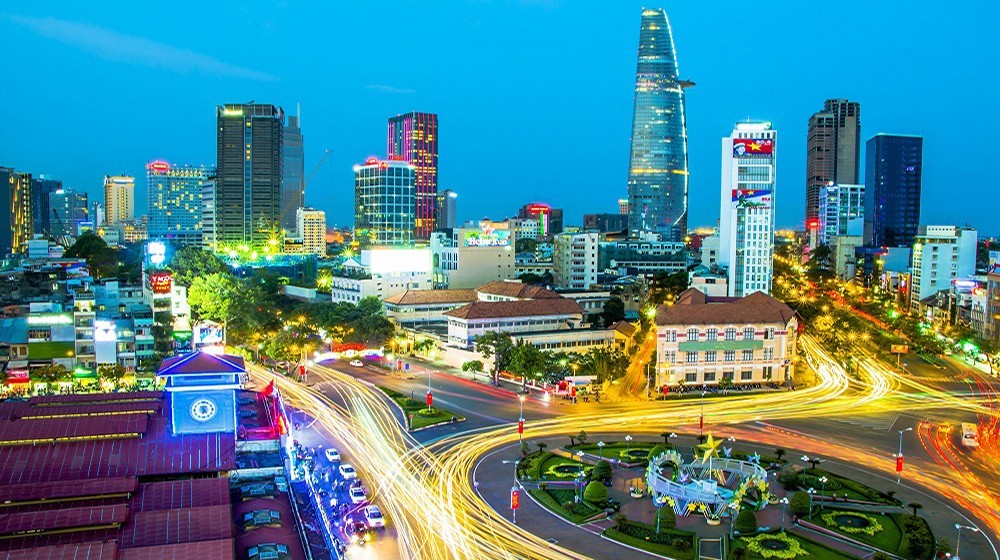
If you’re importing goods into Vietnam rather than exporting, there are additional tax and regulatory considerations. The process is more complex than exports because Vietnam, like most countries, scrutinizes inbound goods more carefully.
Import Restrictions and Prohibitions
Vietnam maintains stricter controls on imports than exports. Prohibited items include similar categories (drugs, weapons, cultural artifacts), plus:
- Used consumer goods in many categories (used electronics, used clothing)
- Right-hand drive vehicles
- Certain media and publications
- Products that don’t meet Vietnamese safety or quality standards
Restricted imports requiring special licenses include automobiles, pharmaceuticals, telecommunications equipment, and chemicals. The licensing process can take weeks or months, depending on the product category.
Vietnam Import Taxes and Thresholds
Understanding Vietnam’s import tax structure is essential for accurate cost planning:
- De minimis threshold: Vietnam eliminated its VND 1 million (~$40) de minimis exemption effective February 18, 2025 under Decision 01/2025/QD-TTg. All imports via express delivery now require customs declarations and are subject to applicable duties and taxes
- VAT (Value Added Tax): Standard rate is 10%, currently reduced to 8% through December 2026 under Resolution 204/2025/QH15 as an economic stimulus measure. Applied to CIF value plus import duties
- Import duties: Range from 0-150% depending on HS code and country of origin, though most consumer goods and commercial items fall in the 5-20% range. Trade agreements significantly reduce or eliminate duties for qualifying goods
- Trade agreements: Vietnam is part of CPTPP, EVFTA, and RCEP, offering reduced or eliminated duties for qualifying goods from member countries
- Special Consumption Tax (SCT): Additional 10-150% tax on luxury goods like alcohol (65%+ as of January 2026, up from 35% under the previous law), tobacco, and automobiles (50-100%)
The total import cost is calculated as: CIF value + Import duty + Special consumption tax (if applicable) + VAT on the cumulative total.
Import Documentation Requirements
Importing requires similar documentation to exports, plus:
- Import license (for restricted categories)
- Certificate of conformity or quality inspection
- Product registration (for pharmaceuticals, cosmetics, medical devices)
- Vietnamese labeling (many products require Vietnamese language labels)
- Importer of record details
- Commercial Invoice
- Packing List
- Bill of Lading (HBL/AWB)
- Certificate of Origin (CO) (if any): this can be used for the duties exemptions.
Import clearance typically takes 3-7 days for standard goods, longer if physical inspections or specialized approvals are required.
At this point, if you’re managing both exports from Vietnam and imports into Vietnam, plus coordinating with multiple suppliers and shipping to multiple destination countries, you’re essentially running a logistics operation alongside your actual business.
How Do You Choose a Shipping Provider for Vietnam?

The right logistics partner depends on your shipping volume, complexity, and whether you need just transport or end-to-end management.
What Logistics Support is Available for Vietnam?
Here’s how different provider types compare:
| Provider Type | What They Handle | Best For |
| Direct Carrier | Airlines or shipping lines; transport only | Decent volume in container level, well-known brands |
| Freight Forwarder | Books transport, handles documentation, coordinates customs brokerage | Standard shipments where you need logistics help but maintain control |
| 3PL (Third-Party Logistics) | Warehousing, order fulfillment, transport, inventory management | E-commerce businesses needing storage plus distribution |
| 4PL (Fourth-Party Logistics) | Orchestrates entire supply chain across multiple carriers, forwarders, and 3PLs | Complex operations: multiple countries, channels, or suppliers |
For businesses starting with Vietnam, a freight forwarder usually makes sense. They know local requirements, handle documentation, and provide competitive rates.
However, as you scale beyond simple shipments, the “Forwarder-only” might not do the job.
Imagine you have stock coming from three different factories in Vietnam. To get that to your final customer, YOU currently have to:
- Coordinate with a local 3PL to consolidate goods from all three factories.
- Chase the Freight Forwarder to book the ocean or air freight for the consolidated batch.
- Manage the broker at the destination for customs clearance.
- Coordinate with the destination 3PL to ensure the Forwarder hands over stock properly for inbound.
That can quickly become overwhelming, and you’ll be spending a huge amount of time and energy on logistics, not on growing your brand.
Why Use a 4PL for Global Logistics?
A 4PL acts as your supply chain control tower, managing the entire logistics network across multiple countries while you focus on your core business. Instead of coordinating freight forwarders, customs brokers, and carriers in Vietnam, the US, Europe, and elsewhere, the 4PL orchestrates everything.
Here’s what a 4PL handles:
- Multi-country supplier coordination: Managing factories across Vietnam, China, India, or wherever you source, consolidating shipments
- Global carrier management: Choosing optimal routes across countries, negotiating volume rates, switching carriers when needed
- Customs compliance everywhere: Handling Vietnamese export requirements, US import regulations, EU compliance, and everything in between
- Multi-modal logistics: Seamlessly combining ocean, air, rail, and truck transport based on your needs
- Technology platform: Single dashboard for real-time visibility across all shipments, wherever they originate
- Problem resolution: One point of contact for issues in any country
When Does a 4PL Make Sense?
Consider a 4PL partner when:
- You’re sourcing from multiple countries (Vietnam plus others)
- You’re selling into multiple markets with different compliance requirements
- You need complex routing (factory to warehouse to customers across regions)
- You want supply chain optimization, not just transactional shipping
- You’re managing multiple sales channels with different fulfillment needs
The value is simple: your team focuses on growing the business, while logistics expertise and optimization are taken care of by your 4PL. For companies managing global e-commerce growth, this operational leverage becomes essential.
Making Shipping To & From Vietnam Easy

Vietnam offers strong opportunities for sourcing, supported by solid infrastructure and improving logistics capabilities. Shipping from Vietnam is manageable with proper documentation, cost understanding, and port knowledge. Import procedures are more complex but navigable.
If you have an established logistics team and straightforward routes, managing this internally is doable.
However, if you’re dealing with multiple suppliers, destinations, or sales channels, it’s far easier to deal with an expert who can manage everything from factory to final delivery. That’s exactly what we do.
Wayfindr is the tech-enabled 4PL logistics partner helping global brands scale effortlessly. Contact our team to learn how we can streamline your shipping processes.