If you’re about to expand into the EU, you’re making a smart move! EU e-commerce turnover reached about €716 billion in 2025, and you’ll be tapping into 448 million potential customers across 27 countries.
It’s safe to say the opportunity is massive. But, as with most things in life, “if it’s worth doing, it’s worth doing right.” First, you need to figure out all the VAT (value added tax) rules, understand CE marking, and decide whether “DDP” sounds more like a shipping term or a typo. (Spoiler: it’s shipping, and yes, it matters.)
Getting your logistics sorted from the start can make a huge difference. Brands live and die on smooth deliveries, known costs, and simple returns processes. And, trust us, Europeans don’t put up with “that’s good enough.”
This guide walks you through everything you need to know about EU e-commerce logistics, from choosing your fulfilment model to understanding de minimis changes and, yes, getting your VAT right. There’s a lot to cover, so grab a coffee and strap yourself in!
How to sell online in Europe? TL;DR:
Market access: The EU offers 448 million customers across 27 countries with unified trade rules and an e-commerce market worth about €716 billion in 2025
Fulfilment model: Start with cross-border shipping if you need to test demand before committing to EU inventory. As orders grow, compare the full cost of direct shipping with local warehousing, including fulfilment fees, delivery costs and returns. The best point to switch depends on your products and customer locations
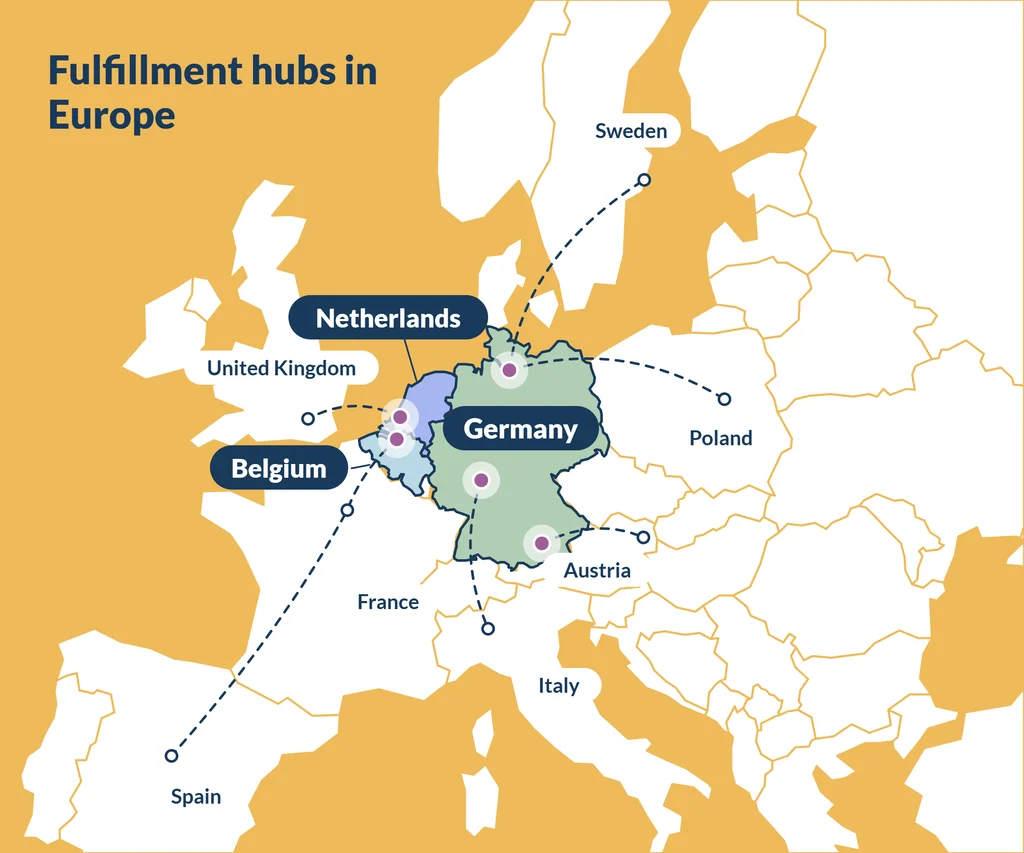
Where to base your EU operation: Germany, the Netherlands, and Belgium are the three most established logistics hubs, each with distinct advantages depending on your target markets. Poland and the Czech Republic can also suit brands serving Central and Eastern Europe
Tax requirements: You’ll need VAT registration and an EORI number if holding stock in the EU, plus an importer of record to handle customs
De minimis changes: Since 1 July 2026, qualifying imports worth up to €150 have faced a temporary €3 customs duty per distinct tariff category in a consignment, not simply €3 per parcel. A separate €2 EU handling fee per customs declaration line applies from 1 November 2026.
Product compliance: CE marking applies only to regulated product categories. Check your category’s rules, including the EU General Product Safety Regulation (GPSR), before you sell
Logistics choice: Ship direct from home (simpler compliance) or use EU fulfilment (faster delivery, better customer experience)
Returns strategy: Plan your returns process upfront, since EU customers have strong consumer protection rights
Working with a 3PL or 4PL: 4PLs and a few 3PLs offer specialist support in the complexities of EU trade, saving you a huge amount of time and stress
Europe’s business-to-consumer e-commerce turnover reached €911 billion in 2025 across 38 European countries, including €715.8 billion in the EU-27, up about 7% on the year before, according to the European E-commerce Report 2026. That means it’s one of the most stable and mature digital markets in the world, which is, of course, a big plus when you’re committing to a new region.
The EU’s unified market structure is another major benefit. Put simply: once you’re compliant and operational in one member country, reaching the other 26 doesn’t require starting from scratch. According to Eurostat data from 2024, 77% of internet users in the EU now shop online, with Ireland (96%), the Netherlands (94%), and Denmark (91%) leading the pack.
European customers do have high expectations, though. Fast shipping, checkout pricing that covers all fees, and simple returns processes are the norm. If you’re shipping with two-week lead times and surprise customs fees at delivery, you’ll find it hard going. That’s why choosing the right fulfilment model can play a critical role.
Which EU E-Commerce Model Is Right for You?
You have two main options for fulfilling EU orders: ship direct from your home country (cross-border fulfilment) or set up local fulfilment within the EU. Going local offers some clear advantages, but it really depends on volumes, your budget, and how fast you want to scale.
Factor
Ship Direct from Home
Local EU Fulfilment
Delivery Speed
7-14+ days
2-5 days
Customer Experience
Possible customs delays & extra fees
Seamless, local experience
Compliance Workload
Lower (fewer registrations)
Higher (VAT, EORI required)
Returns Handling
Complex/expensive
Streamlined
Startup Costs
Lower
Higher (inventory, warehouse)
Best For
Testing market/low volume
Scaling brands
If you’re just testing demand, shipping cross-border from your home country will be the easiest starting point. You’ll avoid upfront inventory commitments and complex tax registrations.
However, once you decide it’s a viable market, compare the full cost of shipping direct with local fulfilment. As volumes grow, local fulfilment can pay off through faster delivery, lower shipping costs per unit, and better conversion rates..
Local Fulfilment in The EU: Centralized or Regional?
Assuming you’ve decided local fulfilment makes sense, the next question is how to structure it. There are two approaches, and it’s usually best to start with one before considering the other.
Centralized fulfilment means one European distribution centre that ships all orders across EU countries. It’s often the better starting point, because it can reduce costs, keep your inventory together, and is significantly easier to manage than running multiple sites.
Regional fulfilment means multiple distribution centres positioned close to your largest customer bases in different parts of Europe. This starts to make sense when you’re shipping high volumes to several EU countries and the shipping costs or lead times from a single central location are becoming a genuine drag on the business. If you’re only just entering the EU, that’s a problem to solve later, not at launch.
In short: start with one strategic location, get it working well, and expand from there.
Where Should You Base Your EU Fulfilment?
Once you’ve decided on a centralized model, you need to pick where in Europe to set up. The best location combines central geography (so you can reach most of the EU efficiently), strong logistics infrastructure, and business-friendly import conditions. Three countries dominate this shortlist:
Germany
Germany has the largest concentration of fulfilment centres and warehouses in the EU, and its central location gives you easy access to most of Europe’s major consumer markets. The World Bank consistently ranks Germany among Europe’s top-performing logistics markets.
The trade-off is availability and cost. Warehouse vacancy rates in key hubs like Düsseldorf and Frankfurt have fallen below 2% in some regions (Mordor Intelligence, 2025), which means competition for space is fierce and rents are rising. Prime logistics rents climbed to €8.85 per square metre in 2025, up 4% year-on-year. That’s the price of Germany’s appeal.
Top logistics regions include Berlin, Frankfurt, Hamburg, Cologne, Düsseldorf, Leipzig, Munich, and Stuttgart.
Germany also has an extensive rail network, which matters as EU sustainability regulations push logistics operators toward lower-emission transport. If your operation will need to scale significantly, Germany’s infrastructure depth is hard to beat.
The Netherlands
The Netherlands sits at the centre of Europe’s three largest economies (Germany, France, and the UK), which makes it one of the most strategically positioned logistics hubs on the continent. The Port of Rotterdam is projected to handle 16.65 million TEUs in 2025, cementing its status as Europe’s busiest container port. Schiphol Airport is the EU’s leading air cargo hub.
The World Bank’s Logistics Performance Index ranks the Netherlands among the top three EU countries for logistics performance, with particular strength in digitalization, which is increasingly important as supply chains become more data-dependent. The country’s advanced customs clearance infrastructure and multimodal transport connections mean goods can move quickly and reliably once they’re in the country.
Key logistics regions include Venlo (consistently rated one of the best warehousing locations in Europe, close to the German border), Tilburg, Rotterdam, and Amsterdam. Like Germany, warehouse availability is tight and getting tighter, so planning ahead matters.
Belgium
Belgium is often underrated as a logistics base, but it makes a strong case. The Port of Antwerp-Bruges handled over 13.5 million TEUs in 2024, making it Europe’s second-largest container port, and DP World has committed €200 million to expand its Antwerp Gateway terminal capacity to 3.4 million TEUs annually by 2025. The country’s road, rail, and inland waterway connections reach the Benelux countries, large parts of France, Germany, and Switzerland efficiently.
Belgium has also seen significant improvement in customs efficiency in recent years, moving from 14th to 7th place in the World Bank’s customs performance rankings. For brands that are particularly sensitive to import processing speed, that’s a meaningful differentiator. Liège Airport is also one of Europe’s leading cargo airports, operating around the clock and handling 1.2 million tonnes of cargo in 2024.
For brands looking to serve both the UK and EU markets from a single base, Belgium’s position makes it worth serious consideration alongside the Netherlands.
Cross-Border Fulfilment to the EU:What’s the Difference Between DDP and DAP Shipping?
As mentioned, setting up a local fulfilment centre is generally the best approach. However, some businesses choose to fulfil every order from their home country until they’re happy that there’s enough demand.
That’s also a sensible move, but if you go that route, you need to decide who pays duties and taxes when your goods enter the EU. This is where you need to know some common shipping jargon (DDP & DAP):
DDP (Delivered Duty Paid): You, the seller, take responsibility for import clearance, duties and relevant taxes. The customer sees the final price at checkout with no surprises at delivery. This creates a smoother experience and typically converts better.
DAP (Delivery at Place): You arrange delivery to the customer, but they normally handle import clearance and pay duties and taxes when the package arrives. You may still see the older term DDU (Delivered Duty Unpaid). This can lead to abandoned deliveries, angry customers, and higher return rates. Not ideal if you want repeat business.
For most e-commerce brands, DDP is the way to go. Yes, it’s more complex on the backend, but it keeps customers happy and removes potential roadblocks in the buying process.
What Are the New EU De Minimis Rules for 2026?
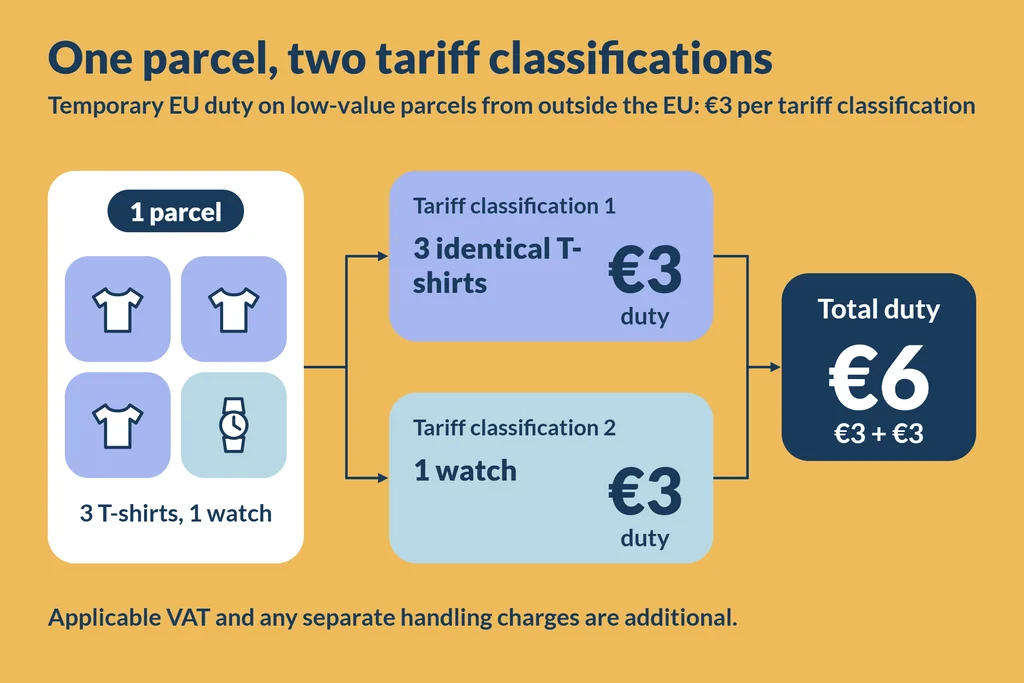
Since 1 July 2026, the EU has applied a temporary €3 customs duty to qualifying low-value goods shipped directly to EU customers from outside the EU. The duty is calculated per distinct tariff classification within a consignment, rather than once per parcel or per individual product.
For example, a parcel containing three identical T-shirts and one watch would attract €6 in customs duty: €3 for the T-shirts and €3 for the watch. Applicable VAT and any separate handling charges are additional.
If you plan to ship small, individual parcels into the EU, this is a pretty big change.
This temporary arrangement is scheduled to remain in place until 1 July 2028, when the EU Customs Data Hub becomes operational, and standard EU tariffs based on product category will apply to all imports regardless of value.
Why the change? The EU received an estimated 4 billion low-value parcels in 2024, and authorities believe around 65% were undervalued to dodge taxes. The new rules level the playing field for EU-based sellers who’ve been competing against duty-free imports.
What this means for you: For brands shipping directly to EU customers, the cost of importing an order now depends partly on the mix of products inside each parcel. That makes it worth comparing the full cost of direct-to-consumer shipping with importing inventory in bulk into an EU warehouse. The better option depends on your product mix, order volumes and delivery requirements.
Many brands are responding by shifting to local EU fulfilment, where they can ship inventory in bulk (paying duties once on the bulk shipment) and then fulfil individual orders domestically without per-parcel duties.
A separate EU handling fee is scheduled to apply from 1 November 2026 to qualifying distance-sales imports. Current Dutch guidance describes a €2 charge per customs declaration line, including shipments above €150.
This fee is separate from the temporary €3 customs duty introduced in July. Sellers should confirm which charges apply to their shipments and who pays them before setting customer delivery prices.
What Are the Tax Requirements for Selling in the EU?
Taxes are where a lot of brands get stressed out, and for good reason. It’s a complex subject that has many variations, depending on your situation. The good news: a strong 4PL, and even some 3PLs, can manage all these things for you.
So, for the masochists reading, how does it all work? Well, if you’re holding inventory in the EU, you need two things: a VAT (Value Added Tax) number and an EORI (Economic Operators Registration and Identification) number.
VAT is charged at different stages of the supply chain. For consumer sales, the rate you charge often depends on the customer’s country and the type of product you’re selling, not simply where your business is registered. How you report that VAT depends on whether you’re importing goods for each order or selling from inventory already stored in the EU.
According to the Tax Foundation’s 2026 data, standard VAT rates across the EU range from 17% in Luxembourg to 27% in Hungary, with an EU average of 21.9%.
The EORI number is your customs identifier. You need it to import goods into the EU and clear customs. Without it, your shipments sit at the border collecting dust and client complaints.
You also need an importer of record (IOR). This is the legal entity responsible for ensuring your goods meet EU regulations, that duties and VAT are paid, and that customs declarations are accurate.
You can either hire a dedicated IOR service, work with an EU-based entity that takes on this role, or partner with a 3PL or 4PL logistics provider who handles it as part of their service.
Disclaimer: This is general guidance. EU tax rules vary by country and product category, so consult with an EU tax professional, customs specialist, or your 3PL/4PL for advice specific to your business.
Which VAT Setup Do You Need For The EU?
Your VAT obligations depend on where your products are shipped from and who is responsible for collecting VAT. Fortunately, the EU offers schemes that can simplify reporting, depending on how you fulfil orders.
Let’s break it down into two common scenarios.
Scenario 1: You Ship Directly from Outside the EU (e.g., from the US or China)
If you ship products directly to EU customers, the Import One Stop Shop (IOSS) can simplify VAT collection for qualifying consignments worth no more than €150.
But IOSS is optional, and not a requirement for every low-value shipment. It covers eligible goods imported from outside the EU, but excludes products subject to excise duties.
If you use IOSS:
VAT is collected from the customer at checkout.
The seller, or marketplace responsible for VAT, reports the sales through a single monthly IOSS return.
The goods can be imported without a second VAT charge when a valid IOSS number is included in the customs declaration.
Most non-EU businesses need an EU-based intermediary to use IOSS, although exceptions apply.
If you don’t use IOSS:
Import VAT still needs to be paid. Depending on the shipment, it may be collected through standard customs procedures or eligible special arrangements. The customer may have to pay VAT through the delivery carrier.
For consignments over €150, IOSS cannot be used. Standard import VAT arrangements apply, and customs duties may also be payable.
Before choosing your shipping model, confirm who will be responsible for VAT and import clearance. That way, your customers know what they’ll pay before their orders arrive.
Scenario 2: You Store Inventory in EU Warehouses
If you import inventory into an EU warehouse before selling it, IOSS no longer applies to sales from that stock.
Instead, you’ll generally need VAT registration in each EU country where your inventory is held.
For eligible sales to consumers in other EU countries, again the Union One Stop Shop (OSS) offers a simpler reporting option.
Here’s how it works:
Local VAT registration: Generally required in each EU country where you hold inventory.
Domestic sales: Usually reported through the relevant country’s VAT return.
Cross-border consumer sales: Qualifying sales from one EU country to another can be reported through a single quarterly Union OSS return.
Union OSS is optional. If you don’t use it, you may need separate VAT registrations in the EU countries where your customers are located.
Crucially, OSS doesn’t replace your local VAT obligations. It also doesn’t generally cover moving your own inventory between warehouses in different EU countries.
Non-EU businesses can use Union OSS for eligible cross-border consumer sales from EU stock.
So, the key question is: Are you shipping orders directly from outside the EU, or fulfilling them from inventory already held inside it? That distinction determines which VAT reporting options may apply.
Quick Decision Guide: What Do I Need?
Where Are Your Goods?
VAT Setup to Check
What It Covers
Shipping directly from outside the EU
Optional IOSS for qualifying consignments up to €150, or applicable import VAT procedures
IOSS simplifies VAT collection and monthly reporting. Without it, import VAT must still be accounted for.
Stored in ONE EU country
Local VAT registration, plus optional Union OSS for eligible cross-border sales
Local VAT returns generally cover domestic sales. Union OSS simplifies reporting for qualifying sales to consumers in other EU countries.
Stored in MULTIPLE EU countries (e.g., Amazon Pan-EU FBA)
Local VAT registration in each storage country, plus optional Union OSS
Local registrations cover relevant domestic obligations and stock movements. Union OSS simplifies reporting for eligible cross-border consumer sales.
Important note: If you sell through a marketplace though, the platform may be responsible for collecting VAT on certain transactions. So, best to confirm who is responsible before choosing your registration setup.
When Does the €10,000 EU VAT Threshold Apply?
The EU has a €10,000 annual threshold for certain cross-border consumer sales, but it doesn’t apply to every business selling within the EU.
To qualify, a seller must be established in only one EU member state and meet the relevant conditions. The threshold covers qualifying intra-EU distance sales of goods alongside certain digital services. The combined value of these supplies must not exceed €10,000 in either the current or previous calendar year.
Below that threshold, eligible sellers can generally apply VAT in their home member state. Above it, VAT is normally due in the customer’s country. Eligible sellers can also choose destination-country VAT treatment before reaching the threshold.
The threshold does not apply to goods shipped directly from outside the EU. It also does not apply to businesses established outside the EU.
But if you’re a non-EU brand storing products in European warehouses, don’t assume the €10,000 threshold exempts you from destination-country VAT obligations. Confirm your registration and reporting requirements before launching.
Amazon will collect VAT on your sales, but you still need the VAT registrations for the countries where goods are stored. Without valid VAT numbers, Amazon blocks inventory transfers between warehouses.
Do You Need a Fiscal Representative?
Fiscal-representation requirements vary by country and business structure. Some non-EU sellers must appoint a local fiscal representative (an EU-based intermediary) for particular VAT obligations, while others can register directly. Before registering, confirm the requirements in each country where you plan to hold inventory or have VAT obligations.
IOSS is optional: It simplifies VAT collection for eligible low-value consignments shipped directly to EU consumers from outside the EU.
Import VAT still applies without IOSS: The applicable import procedure determines how it is collected.
Holding EU inventory generally requires local VAT registration: Check the obligations in each country where you store stock.
Union OSS is optional: It simplifies reporting for qualifying cross-border consumer sales within the EU, but doesn’t generally cover domestic sales or stock transfers.
The €10,000 threshold has strict conditions: It isn’t available to businesses established outside the EU.
Keep accurate records: Transaction records covered by IOSS and Union OSS must generally be retained for 10 years.
How Do You Ensure Product Compliance for EU Sales?
Product compliance is another important detail. You can’t just list your products online and hope for the best. If your goods don’t meet EU standards, they’ll get stuck at customs or worse, pulled from sale and destroyed.
The specific requirements depend heavily on what you’re selling. Some product categories require CE marking, which indicates that your product meets EU health, safety, and environmental standards.
This applies to regulated categories like electronics, toys, and certain machinery, not to everything you might sell.
The EU General Product Safety Regulation (GPSR) applies to a broad range of consumer products and has been in force since 13 December 2024. Depending on the product and how you sell, requirements can include product traceability, safety information and an EU-based responsible economic operator.
Check the rules for your exact product category before importing stock or listing products for EU customers. See how Wayfindr supports EU compliance, including CE marking, GPSR and EPR.
Here’s a breakdown of compliance by product category:
What Product Documentation Do You Need For EU Compliance?
For products requiring CE marking, you’ll need technical documentation that proves compliance. This typically includes test reports, manufacturing specifications, risk assessments, and an EU Declaration of Conformity.
You don’t submit these documents with every shipment, but you must have them ready if requested by customs or market surveillance authorities. Think of it like proof of insurance. You hope you never need to show it, but you’re in trouble if you don’t have it.
Labels also matter. Many products require information in the local language of the country where they’re sold, including safety warnings, ingredient lists, and care instructions.
Are There Country-Specific Requirements For EU Product Compliance?
Once you’re compliant in one EU country, you’re mostly good across all 27. The CE marking and core EU regulations apply union-wide.
However, some countries add extra requirements. Germany and France, for example, both require brands to register for EPR (Extended Producer Responsibility) programs if you’re selling products with packaging.
This is an environmental regulation that makes you financially responsible for the collection and recycling of your packaging materials.
EPR registration isn’t horrendously complicated, but it’s another administrative step you need to complete before you start selling. Fees vary by country and product category, and non-compliance can result in fines or being blocked from selling altogether.
What Logistics Setup is Best for EU E-Commerce?
Getting products into the EU and then to your customers requires several moving pieces. You’ll need some combination of the following providers:
Importer of record: Ensures your goods clear customs legally and that duties/VAT are paid
Customs broker: Handles the paperwork and coordination with customs authorities
VAT specialist/fiscal representative: Manages VAT registrations, filings, and compliance across EU countries
Product compliance consultant: Ensures your products meet EU regulations (CE marking, technical documentation, category-specific certifications)
Freight forwarder: Manages the shipment of goods from your origin country to the EU
Warehouse/fulfilment centre: Stores your inventory and picks, packs, and ships individual orders
Last-mile carriers: Deliver packages from the fulfilment centre to customers’ doors
4PL (& some 3PLs): Combines all of the above.
You can hire each of these separately, which gives you control but also requires you to coordinate between multiple vendors. If one link in the chain breaks down, you’re the one troubleshooting.
Your product category can also affect the logistics setup you need. Cosmetics, for example, have specific EU compliance requirements that need to be addressed before they can be placed on the market. Our guide to importing cosmetics from China into the EU explains what beauty brands need to prepare before arranging freight and fulfilment.
If the last few sections made your head spin, this is where there’s a bit of good news. Fourth-party logistics (4PL) providers are specialists in coordinating all the moving pieces. In short, they can sort out all the tax, compliance, and other issues for you.
Some third-party logistics (3PL) companies also provide this type of support, but it’s not their bread-and-butter. 3PLs own and operate all the things needed to deliver your products. They’re the “doers,” and 4PLs are the “coordinators.”
Another key difference is scope: many 3PLs operate in specific regions, such as Europe. That’s ok if you’re only selling in one or two markets. But if you’re expanding globally, 4PLs make more sense, as they usually offer a worldwide network. Confused? Read our blog detailing the difference between a 3PL and a 4PL.
What Are Common Mistakes When Selling in the EU?
Even experienced brands make these errors when expanding to Europe. Here’s what to avoid:
Not clarifying VAT/duty responsibility at checkout: Customers hate surprise fees at delivery. Make it clear upfront what they’re paying.
Missing or incomplete returns strategy: EU consumers have strong return rights (often 14 days minimum by law). Plan for this from day one.
Underestimating category-specific compliance: Assuming your products are fine without checking specific EU requirements for your category is a fast track to customs issues.
Unclear documentation ownership for customs: If your freight forwarder, your manufacturer, and your customs broker are all pointing fingers when something goes wrong, that’s a problem.
Ignoring EPR requirements in applicable countries: Packaging regulations in Germany and France aren’t optional. Skipping them can get you fined or blocked from selling.
Not planning for customer service in local languages/timezones: EU customers expect support in their language during their business hours, not just yours.
Underestimating low-value import duties: The €150 customs duty exemption ended on 1 July 2026. Qualifying shipments now face a temporary €3 duty per distinct tariff category, not per parcel. Factor the product mix into your landed-cost calculations.
How Do Brands Successfully Navigate EU Expansion?
Understanding the theory is one thing. Seeing it work in practice helps even more.
Client profile:Rascal & Friends, a diaper brand initially launched in New Zealand and Australia in 2018, decided to expand into European markets (UK and EU)
With production based in China and major retail partnerships lined up with Tesco UK (United Kingdom) and AS Watson in the Netherlands (EU), the brand needed a supply chain that could meet domestic delivery timelines instead of traditional FOB shipping schedules.
Problem: Expanding into UK and EU markets quickly brought serious supply chain complexity. Major European retailers expected domestic supply capabilities, but shipping from China on a standard FOB timeline (4-6 weeks ocean freight plus clearance) wouldn’t meet their restocking requirements.
The brand needed a way to supply retailers as if they were a local supplier, without the financial pressure of holding months of excess inventory in multiple European countries.
What changed:
Designed a domestic supply chain model with Wayfindr coordinating between Tesco UK, AS Watson Netherlands, and China-based production
Implemented a unique workflow where inventory was strategically positioned in Europe to enable domestic fulfilment speeds while optimizing cash flow
Established clear importer of record and customs clearance processes for UK and Netherlands operations
Created delivery schedules that aligned with retailer replenishment cycles rather than traditional shipping timelines
Consolidated logistics management across both UK and EU markets through a single 4PL partnership, avoiding the need to coordinate multiple regional providers
Outcome: Two years into the European expansion, Rascal & Friends became a prominent brand on shelves with both Tesco and AS Watson. The domestic supply model successfully enabled the brand to compete with local suppliers on delivery speed and reliability.
Both the brand and the retailers discovered that creative supply chain solutions can open doors for international suppliers to meet domestic retailer requirements, broadening the product and brand mix available to European consumers. This example shows how local inventory can support retail distribution in Europe; the economics of direct-to-consumer fulfilment should be assessed separately.
Note: Results vary by product category, volume, and market conditions.
Conclusion
Selling in the EU offers incredible opportunity, but it requires more planning than throwing up a website and hoping for the best. Tax registrations, product compliance, and fulfilment strategy all need to align before you start seeing consistent sales and happy customers.
The brands that succeed in Europe are the ones that treat logistics as a competitive advantage, not an afterthought.
Whether you choose to ship direct while testing demand or commit to local fulfilment for faster delivery, the key is understanding your options and making informed decisions based on your business goals.
Planning your EU fulfilment setup? Wayfindr can help you assess where to position inventory and how to build a fulfilment network around your customer demand. Talk to our EU team about the logistics model that fits your expansion plans.
Nick co-founded Wayfindr to help brands design and build market-leading carbon-neutral D2C logistics. As Director, he brings 15+ years of experience across logistics, marketing, supply chain and retail from Asia Pacific to the world.
You have a few options. You can hire each specialist separately (VAT consultant, customs broker, freight forwarder, warehouse, etc.) and coordinate them yourself. Alternatively, many 3PL providers offer basic services like warehousing and customs clearance, though VAT and compliance support varies by provider. 4PL providers typically offer the most comprehensive solution, managing your entire supply chain including VAT registration, product compliance, customs, and fulfillment through their network of specialists.
No. You need an importer of record and proper VAT registration if holding inventory in the EU, but you don’t need to establish a legal entity. Many brands work with logistics partners or third-party services that provide these functions.
DDP means you pay all duties and taxes upfront, so customers see the final price at checkout. DAP (often still called DDU) means customers normally pay duties and taxes at delivery, which can lead to abandoned packages and unhappy customers. Most successful EU e-commerce brands use DDP.
Typically 4-12 weeks, depending on the country. Faster countries include Italy, Austria, and Poland. Germany, France, and Spain take longer. Start well before you plan to launch, as you cannot legally sell with inventory in the EU without a valid VAT number.
It depends on your setup. With the OSS scheme, you can register in one EU country and report VAT on eligible cross-border sales to consumers through that single registration. However, if you’re storing inventory in multiple countries, you typically need local VAT registrations where stock is held.
Customs will likely refuse entry, and your shipment will be held, returned, or destroyed. If non-compliant products make it through and are discovered later, you could face fines, product recalls, and being banned from selling in the EU.
Since 1 July 2026, qualifying low-value shipments entering the EU have faced a temporary €3 customs duty per distinct tariff classification. For example, a parcel containing three identical T-shirts and one watch would attract €6 in duty rather than a flat €3 parcel charge.
For small businesses shipping directly to EU customers, this can increase landed costs. VAT and any separate handling fees must also be accounted for. Compare these costs against importing stock in bulk and fulfilling orders from within the EU.
Subscribe
Never miss an article. Subscribe To Our Newsletter Today.
News & Resources
Wayfindr Insights
The best thing about logistics? There’s no shortage of things to learn.
We’re here to make things simpler for you – we won’t spam your inbox or blow up your phone. When you enter your information:
(Within 24 hours) A member of the Wayfindr team will read your request and schedule a meeting by email. A more in-depth form will be attached to the email.
We will ask you about your needs and specific logistics requirements.
We will take your information and put together a plan designed for your business.